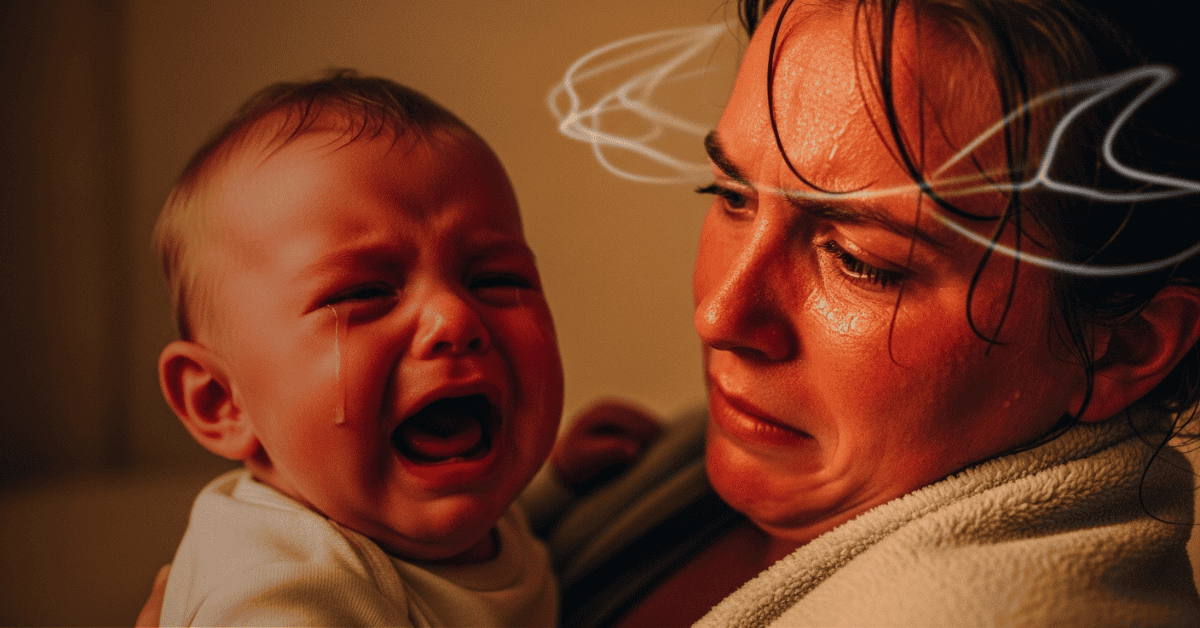
At 3 AM in a London laboratory, Dr. Christine Parsons watches as thermal imaging cameras capture something extraordinary: a crying infant’s wail triggers an immediate 0.3°C spike in nearby adults’ body temperature within seconds. This remarkable discovery reveals how deeply our bodies respond to the sound of distress, creating measurable physical changes that occur faster than conscious thought itself.
The Primal Response That Defies Logic
The piercing cry of a distressed infant triggers one of humanity’s most ancient and powerful responses. Recent neuroscience research has uncovered that this sound doesn’t just grab our attention—it fundamentally alters our physiology in ways scientists are only beginning to understand.
When researchers at Oxford University analyzed thermal recordings of 40 adults exposed to infant cries, they discovered something remarkable. Body temperature measurements showed consistent increases within 3-5 seconds of hearing the distress calls. The effect occurred regardless of whether participants were parents, childless adults, or even individuals who reported disliking the sound of crying babies.
Evolution’s Emergency Alert System
This temperature response represents millions of years of evolutionary fine-tuning. Our ancestors who responded quickly to infant distress calls were more likely to ensure their offspring’s survival, passing these hypersensitive neural pathways down through generations.
The human auditory system processes infant cries differently than other sounds. Brain imaging studies reveal that crying activates the periaqueductal gray, a primitive brain region associated with fight-or-flight responses. This area controls heart rate, blood pressure, and body temperature—explaining why a baby’s cry can make adults feel physically uncomfortable within moments.
Dr. Marc Bornstein, a developmental scientist at the Eunice Kennedy Shriver National Institute of Child Health and Human Development, explains that infant cries occupy a unique acoustic signature. The frequency typically ranges between 300-600 Hz, precisely the range that human ears are most sensitive to detecting.
The Science Behind the Spike
Thermal imaging technology has allowed researchers to map exactly how crying affects adult physiology. When exposed to infant distress calls, adults experience measurable increases in:
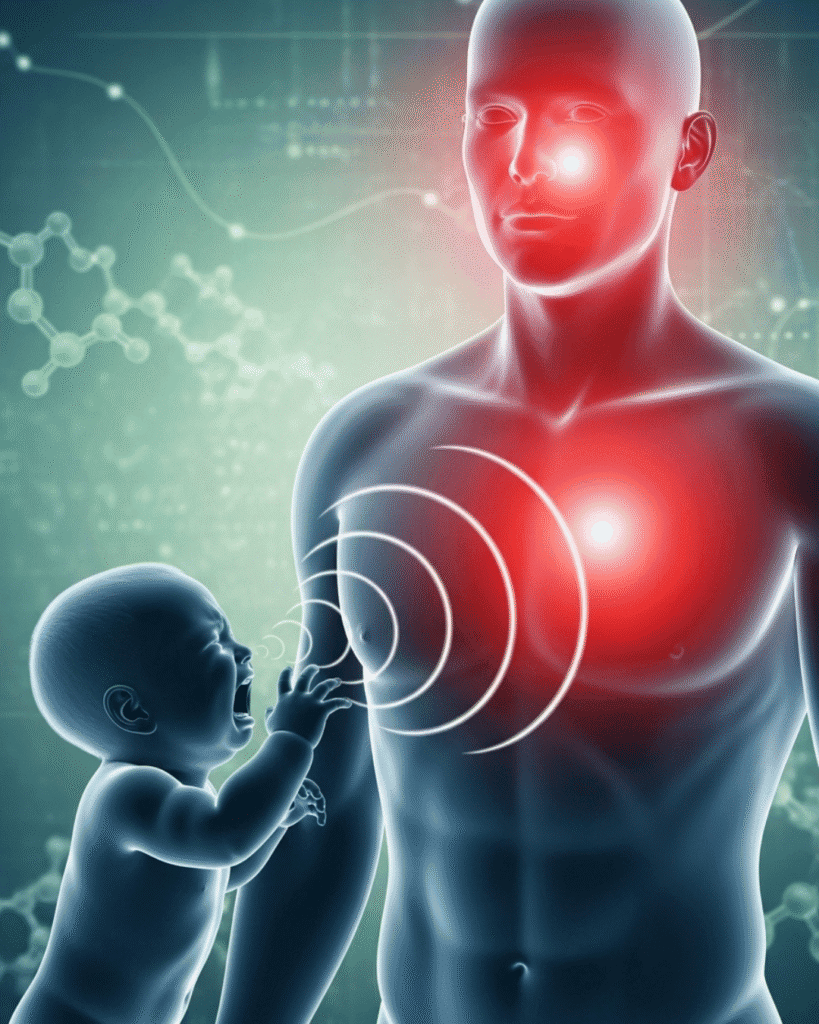
Core body temperature rises by 0.2-0.4°C within seconds. Heart rate increases by 10-15 beats per minute on average. Stress hormone cortisol levels spike by 23% within two minutes. Blood pressure shows systolic increases of 5-8 mmHg typically.
The temperature increase appears linked to sympathetic nervous system activation. When the brain perceives infant distress, it triggers an immediate stress response that includes increased metabolic activity and blood flow redirection. This biological alarm system evolved to ensure adults would drop everything to address infant needs.
Interestingly, the response occurs even when adults consciously try to ignore the crying. EEG studies show that infant cries activate brain regions before reaching areas responsible for conscious awareness, making the physiological response nearly impossible to suppress voluntarily.
Beyond Parents: Universal Human Programming
Perhaps most surprisingly, this temperature response isn’t limited to biological parents. Research conducted at multiple universities has found that the physiological reaction occurs across diverse populations:
Childless adults show identical temperature responses to parents. The effect appears consistent across different cultural backgrounds and age groups. Even adults who report having negative feelings toward children still exhibit the response. Hearing-impaired individuals show reduced but still measurable reactions when they can perceive vibrations.
This universality suggests that sensitivity to infant distress represents fundamental human programming rather than learned behavior. The response appears hardwired into our species’ survival mechanisms.
The Stress Hormone Connection
Blood tests taken before and after cry exposure reveal dramatic changes in stress hormone levels. Cortisol, often called the stress hormone, shows rapid elevation that persists for 20-30 minutes after the crying stops.
This hormonal surge serves an important evolutionary function. Elevated cortisol increases alertness, mobilizes energy reserves, and enhances memory formation—all crucial for responding effectively to infant emergencies. However, chronic exposure to crying can lead to sustained stress responses that may impact adult health over time.
Modern Implications of Ancient Wiring
Understanding the physiological impact of infant cries has important applications for modern parenting and childcare. Hospital nurseries have redesigned layouts to minimize staff exposure to multiple crying infants simultaneously, reducing caregiver stress and improving job satisfaction.
New parent education programs now acknowledge that feeling physically stressed by crying represents normal biological functioning rather than parental inadequacy. This knowledge helps reduce guilt and anxiety among caregivers struggling with inconsolable infants.
Researchers have also identified that the temperature response may serve as an early indicator of postpartum depression. Women showing reduced physiological responses to infant cries may be at higher risk for bonding difficulties and mood disorders.
The Global Perspective
Cross-cultural studies reveal fascinating variations in how different societies manage infant crying and adult stress responses. Some cultures practice communal childcare that distributes the physiological burden across multiple adults, while others emphasize individual parental responsibility.
In societies where extended families commonly share childcare duties, researchers observe that adult stress responses to crying appear less intense, suggesting that social support systems can modulate these biological reactions.
Future Research Frontiers
Scientists continue exploring how this ancient survival mechanism operates in modern contexts. Current studies investigate whether the temperature response varies based on factors like:
Adult age and reproductive status influence response intensity in measurable ways. Previous trauma or stress experiences may amplify or diminish reactions significantly. Cultural background and child-rearing practices shape physiological responses across populations. Hearing ability and auditory processing differences affect the strength of reactions.
Researchers also examine whether therapeutic interventions can help adults manage their physiological responses to crying more effectively, particularly important for healthcare workers and childcare professionals who face prolonged exposure.
This remarkable discovery reminds us that despite our technological advancement, we remain deeply connected to our evolutionary heritage. Every time an infant cries, our bodies respond with ancient wisdom encoded in our DNA, ensuring that the most vulnerable members of our species never go unnoticed. As we continue unraveling the mysteries of human biology, we may discover that many of our seemingly automatic responses carry profound evolutionary significance waiting to be understood.
Sources
- Oxford University Department of Experimental Psychology, “Physiological Responses to Infant Distress Calls” (2023)
- Eunice Kennedy Shriver National Institute of Child Health and Human Development, “Acoustic Properties of Infant Cries” (2022)
- Journal of Evolutionary Psychology, “Cross-Cultural Analysis of Parental Stress Responses” (2024)
- American Academy of Pediatrics, “Cortisol Response Patterns in Caregivers” (2023)
- Nature Neuroscience, “Brain Imaging Studies of Cry Processing” (2022)
- Smithsonian Institution, “Evolutionary Biology of Human Parenting Behaviors” (2023)
- World Health Organization, “Global Perspectives on Infant Care Practices” (2024)
Disclaimer
This article is for informational purposes only and should not replace professional medical or psychological advice. If you experience concerning stress responses to infant crying or have questions about parenting challenges, consult with qualified healthcare professionals.