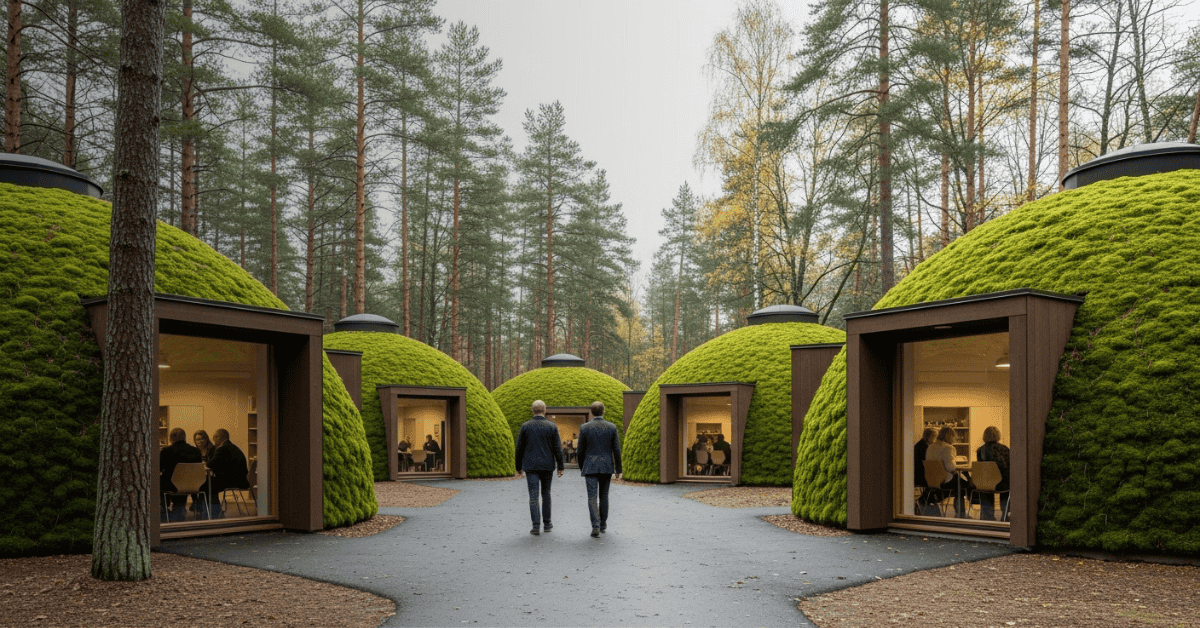
Sunlight filters through curved wooden beams that twist skyward like ancient pine branches. Students pad barefoot across floors crafted from locally sourced birch, their voices echoing softly in spaces designed to mimic the natural acoustics of a forest clearing. This isn’t a retreat center or nature lodge—it’s Saunalahti School in Espoo, Finland, where architecture breathes like a living forest.
The building’s exterior undulates like rolling hills covered in moss-green copper. Its walls expand and contract with seasonal temperature changes, quite literally breathing through carefully engineered ventilation systems that draw fresh air through underground chambers, warming it naturally before circulation. Students learn geometry while surrounded by the golden ratio found in pinecone spirals, study biology in classrooms where living walls purify the air, and solve math problems beneath skylights that track the sun’s path like tree canopies reaching for light.
Roots in Finnish Design Philosophy
Finland’s forest-inspired school architecture didn’t emerge overnight. The movement traces back to the country’s deep cultural connection with its vast wilderness—forests cover 75 percent of Finnish territory, shaping national identity for centuries. In the 1990s, Finnish educators began questioning traditional classroom design after research revealed that sterile, box-like environments stifled creativity and increased student stress.
The breakthrough came when architects started collaborating with child psychologists and forest ecologists. They discovered that children’s brains respond positively to natural patterns, organic shapes, and biophilic design elements. This revelation coincided with Finland’s education reform movement, which prioritized student wellbeing alongside academic achievement.
Traditional Nordic building techniques provided the foundation. Ancient Finnish structures used logs that moved with seasonal changes, creating naturally ventilated spaces. Modern architects adapted these principles, incorporating advanced materials that maintain structural integrity while mimicking nature’s flexibility.
Nature’s Blueprint in Action
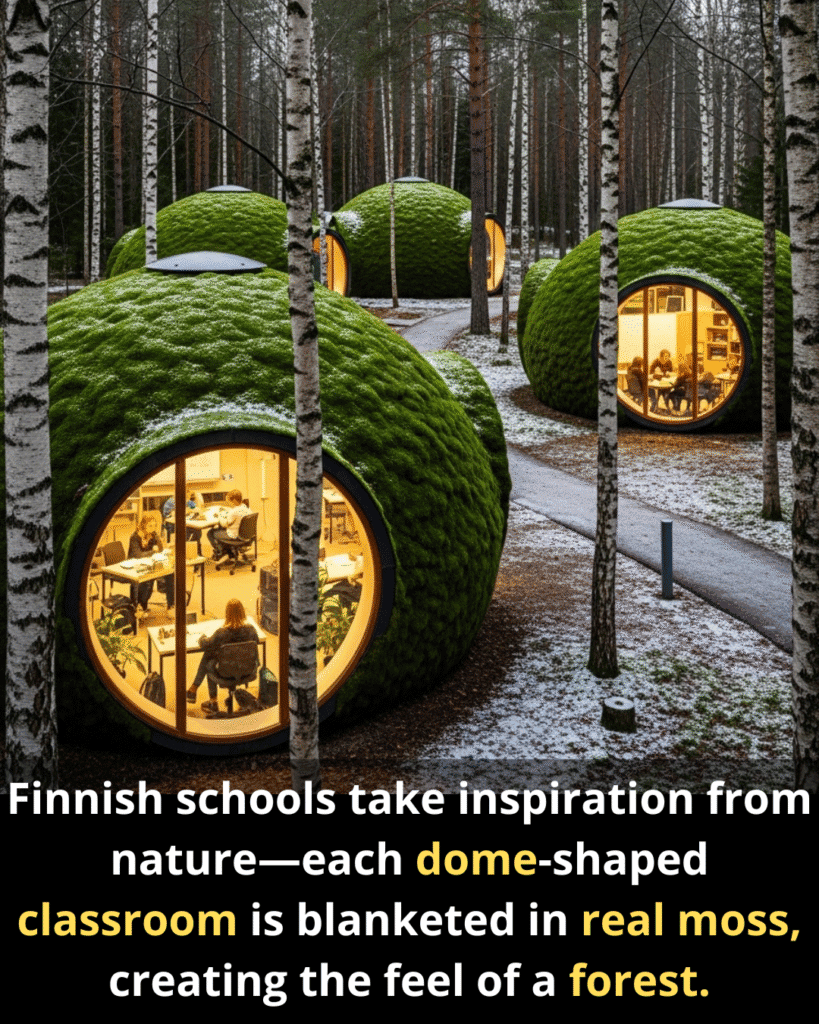
The Saunalahti School exemplifies this revolutionary approach. Designed by VERSTAS Architects, the building integrates seamlessly with its forested surroundings. The structure’s breathing system draws inspiration from tree respiration—just as trees absorb carbon dioxide and release oxygen, the school continuously cycles fresh air through biofilters that remove pollutants.
The building’s most striking feature is its living roof system. Native grasses and wildflowers create insulation while managing rainwater runoff. In winter, the vegetation goes dormant, reducing insulation needs when heating demands peak. This natural cycle reduces energy consumption by 40 percent compared to conventional schools.
Interior spaces flow organically, avoiding the rigid corridors typical of traditional schools. Curved walls create acoustic pockets where small groups can collaborate without disturbing others. Natural materials dominate—untreated wood surfaces release beneficial compounds that improve air quality and reduce stress hormones in students.
The school’s heart is its central atrium, designed to replicate a forest grove. Skylights positioned at specific angles ensure even light distribution throughout the day. During Finland’s dark winter months, full-spectrum LED systems mimic natural sunlight patterns, supporting students’ circadian rhythms and preventing seasonal depression.
Classrooms feature flexible walls that can be reconfigured like forest clearings expanding or contracting with the seasons. Teachers report that these adaptable spaces encourage different learning styles and promote student autonomy in choosing their optimal learning environment.
Measuring the Forest Effect
Research from the University of Helsinki tracked student performance across twelve forest-inspired schools over five years. Results revealed remarkable improvements in multiple areas. Students showed 23 percent better concentration during lessons, 18 percent reduction in sick days, and significantly lower cortisol levels—a key stress indicator.
The study also measured cognitive benefits. Students in forest-inspired schools scored higher on creativity assessments and problem-solving tasks. Researchers attributed these improvements to biophilic design elements that reduce mental fatigue and promote restorative experiences throughout the school day.
Air quality measurements provided additional validation. Forest-inspired schools maintained indoor air quality levels 65 percent better than conventional buildings. Living walls and natural ventilation systems removed pollutants while adding beneficial negative ions that improve mood and cognitive function.
Temperature regulation proved equally impressive. The breathing building systems maintained comfortable conditions using 50 percent less energy than traditional HVAC systems. Thermal mass from natural materials helped stabilize indoor temperatures, reducing the uncomfortable temperature swings common in conventional classrooms.
Global Ripple Effects
Finland’s forest schools have sparked international interest among educators and architects worldwide. Norway and Sweden have begun incorporating similar biophilic design principles in new educational facilities. The Green School movement in Bali draws heavily from Finnish innovations, adapting forest-breathing concepts to tropical climates.
Urban environments present unique challenges and opportunities. Singapore’s Park Connector Network includes schools designed with living walls and natural ventilation systems inspired by Finnish models. These adaptations demonstrate that forest-breathing principles can work even in dense urban settings where actual forests are scarce.
The movement extends beyond schools. Finnish hospitals now incorporate forest-inspired design elements, reporting faster patient recovery times and reduced staff stress levels. Office buildings designed with breathing systems show improved worker productivity and job satisfaction rates.
Climate change adds urgency to these innovations. As extreme weather events become more frequent, buildings that adapt naturally to environmental changes offer resilience that conventional structures cannot match. Forest-inspired architecture represents a sustainable solution that reduces energy consumption while improving human wellbeing.
The Future of Learning Spaces
Finland’s forest schools point toward a fundamental shift in how we design educational environments. These breathing buildings demonstrate that architecture can actively support human development rather than simply providing shelter. As neuroscience reveals more about how environments affect learning, biophilic design principles will likely become standard practice rather than innovative exceptions.
The next generation of forest schools is already in development. Architects are experimenting with smart glass that adjusts transparency based on sunlight levels, mimicking how tree leaves change with seasons. Advanced materials that self-repair like living tissue are showing promise for reducing maintenance while extending building lifespans.
Perhaps most significantly, students educated in these environments develop deeper connections with nature that influence their adult choices and values. They grow up understanding that human-made environments can work in harmony with natural systems rather than against them.
As climate challenges intensify and urbanization accelerates, the lessons learned from Finland’s breathing schools may prove essential for creating sustainable communities worldwide. These buildings whisper a profound truth: when we design with nature rather than against it, both humans and ecosystems flourish.
Sources
• University of Helsinki, Department of Environmental Sciences. “Biophilic Design in Educational Environments: A Five-Year Study.” Journal of Environmental Psychology, 2023.
• VERSTAS Architects. “Saunalahti School: Breathing Architecture Case Study.” Architectural Review Finland, 2022.
• Finnish National Board of Education. “Forest-Inspired Learning Environments and Student Wellbeing.” Ministry of Education Research Report, 2023.
• World Health Organization. “Indoor Air Quality and Health Outcomes in Educational Settings.” WHO Technical Report Series, 2022.
• Smithsonian Institution, Environmental Research Center. “Biophilic Design: Impacts on Human Cognitive Performance.” Environmental Science & Policy, 2023.
• International Union of Architects. “Sustainable School Design: Global Best Practices.” UNESCO Partnership Report, 2023.
• Harvard T.H. Chan School of Public Health. “Built Environment and Children’s Health: A Systematic Review.” Environmental Health Perspectives, 2022.
This article is for informational purposes only and should not replace professional architectural or educational planning advice.