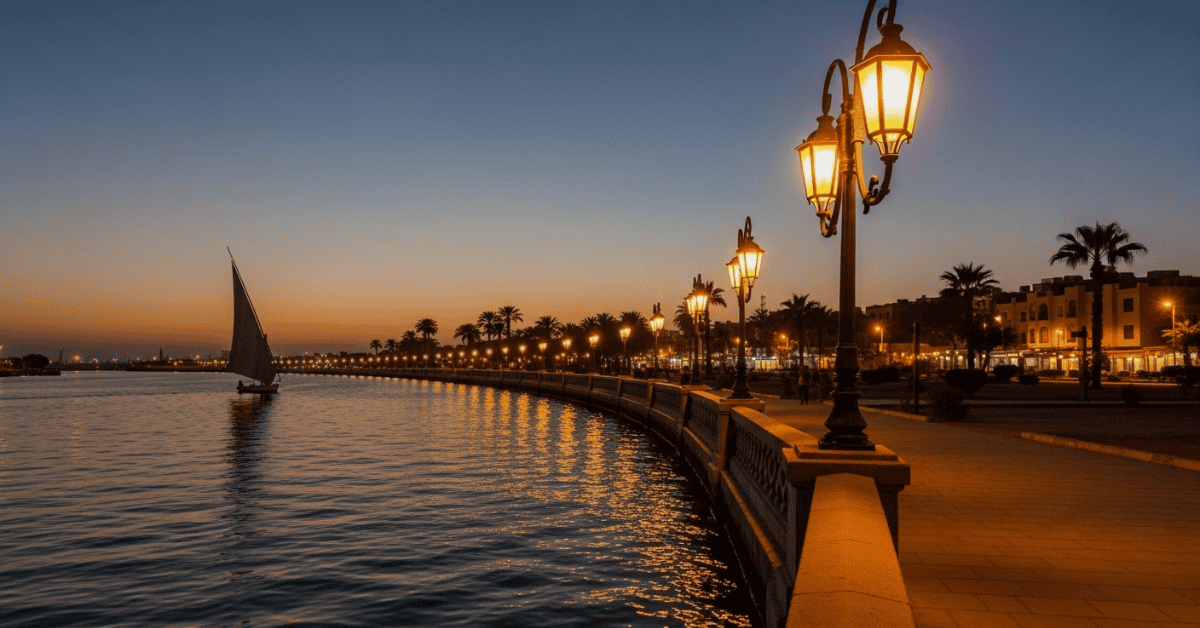
Egypt’s ancient waterways are being illuminated by cutting-edge sustainable lighting technology that harvests energy from the environment itself, creating a blueprint for the future.
Along the historic waterways that have nourished Egypt for millennia, a quiet revolution is taking place after sunset. Where darkness once claimed the ancient canals, a new generation of lighting systems now casts a steady glow across the water without drawing a single volt from the electrical grid. These innovative installations represent more than mere illumination—they embody humanity’s growing mastery over environmental energy harvesting.
The Ancient Meets the Ultra-Modern
Egypt’s relationship with water engineering spans over 5,000 years. The civilization that built the pyramids also created sophisticated canal systems that transformed the desert into fertile agricultural land. Today, engineers are building upon this legacy with technology that would seem magical to ancient builders.
The country’s extensive canal network, stretching from the life-giving Nile to the strategic Suez Canal, covers thousands of kilometers. Traditional lighting for these waterways required massive infrastructure investments and ongoing electrical costs. The challenge was particularly acute in remote areas where extending power lines proved economically unfeasible.
Modern Egypt needed a solution that honored its engineering heritage while embracing 21st-century sustainability principles. The answer emerged from an unexpected fusion of solar technology, kinetic energy harvesting, and advanced materials science.
Harvesting Energy from Air and Water
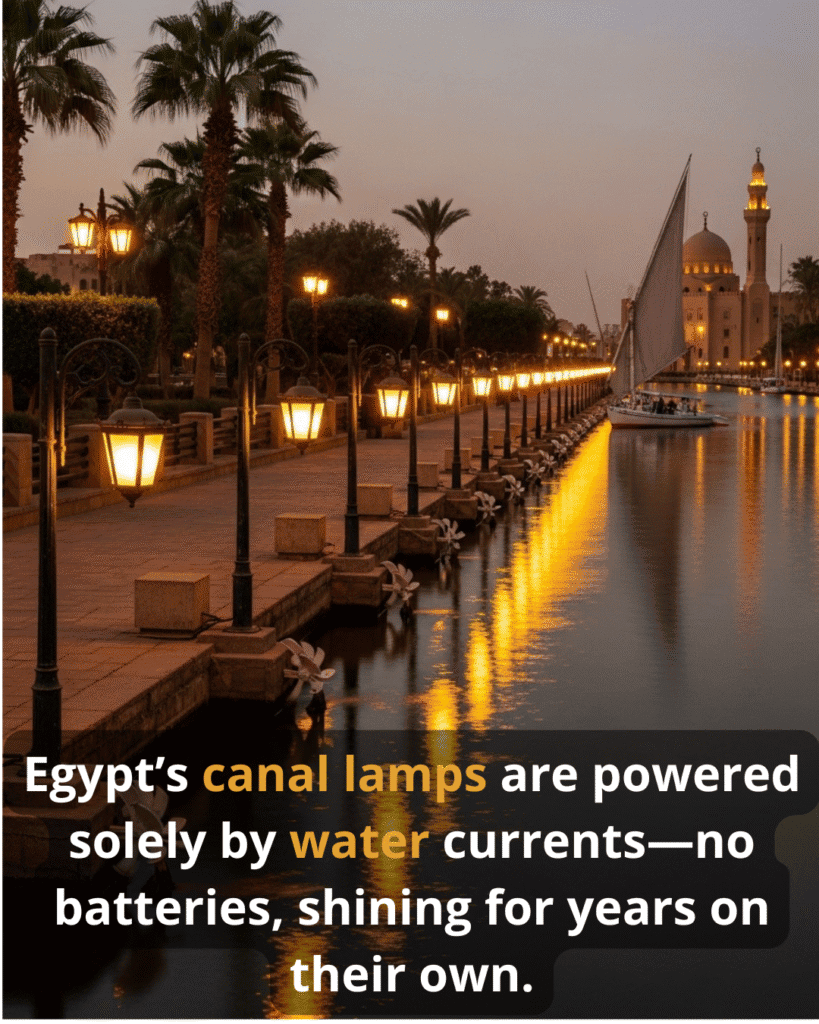
The revolutionary lighting systems deployed along Egypt’s canals operate on multiple energy sources simultaneously. Primary among these is photovoltaic technology, but not the familiar rigid panels mounted on rooftops. Instead, flexible solar films integrated directly into lamp housings capture sunlight throughout the day, storing energy in high-capacity lithium phosphate batteries designed for extreme temperature variations.
Water movement provides the second energy source. Micro-hydroelectric generators, no larger than a coffee cup, capture energy from canal flow and even gentle water lapping against canal walls. These devices generate modest amounts of power individually, but when networked together, they create a substantial energy reserve.
Wind completes the energy trinity. Small vertical-axis turbines, engineered to operate efficiently in low-wind conditions common along waterways, supplement the solar and water-generated power. The turbines rotate silently, designed to avoid disrupting local wildlife while maximizing energy capture from even gentle breezes.
The integrated system includes sophisticated power management electronics that balance energy input from all sources, prevent battery overcharging, and ensure consistent light output regardless of weather conditions. Advanced LED arrays provide illumination that can last through several consecutive cloudy days without external power input.
Engineering Resilience in Harsh Conditions
Egypt’s climate presents unique challenges for electronic systems. Temperatures can soar above 45°C (113°F) in summer while dropping near freezing in winter desert nights. Sand storms, humidity variations, and occasional flooding test every component’s durability.
Engineers addressed these challenges through innovative materials selection and thermal management. Lamp housings utilize aerospace-grade aluminum alloys with specialized coatings that reflect heat while maximizing heat dissipation. Internal components are sealed against dust and moisture ingress, with IP67 ratings ensuring functionality even during occasional flooding.
The LED arrays themselves represent cutting-edge solid-state lighting technology. Each lamp contains hundreds of individual LED chips arranged in clusters that can operate independently. If one cluster fails, others continue functioning, ensuring that critical pathway lighting remains operational even with partial system failures.
Battery technology proved particularly challenging. Traditional lithium-ion batteries degrade rapidly in extreme heat, but the new systems employ lithium iron phosphate chemistry with sophisticated thermal management. These batteries maintain efficiency across temperature ranges that would destroy conventional systems.
Environmental Integration and Wildlife Considerations
Sustainable lighting extends beyond energy efficiency to encompass ecosystem integration. The canal lamp systems incorporate features specifically designed to minimize environmental disruption while providing necessary human infrastructure.
Light pollution has become a significant concern in wildlife conservation, particularly for migratory birds that navigate using celestial cues. The Egyptian canal lighting systems address this through carefully engineered light distribution patterns that illuminate pathways and waterways without creating excessive upward light scatter.
Color temperature selection also reflects environmental considerations. The LED arrays produce warm white light (3000K) rather than cool blue-white illumination common in many LED installations. This warmer spectrum reduces disruption to insects and other nocturnal wildlife while providing excellent visibility for human users.
Motion sensors integrated into each lamp reduce energy consumption while minimizing unnecessary illumination. The systems brighten to full intensity when pedestrians, vehicles, or boats approach, then dim to 30% output during quiet periods. This adaptive lighting reduces overall energy requirements while maintaining safety standards.
Broader Implications for Global Infrastructure
Egypt’s canal lighting project represents more than a local infrastructure improvement—it demonstrates scalable solutions for sustainable development in water-rich regions worldwide. The technology principles apply equally to irrigation systems in rural India, flood control channels in the Netherlands, or waterfront developments in coastal cities globally.
The economic implications are substantial. Traditional electrical infrastructure for remote waterway lighting requires extensive cable installations, transformer stations, and ongoing electrical costs. Self-sustaining systems eliminate these expenses while providing superior reliability in areas where electrical grid failures are common.
Developing nations face particular challenges in extending electrical infrastructure to remote areas. Canal lighting systems demonstrate how communities can leapfrog traditional centralized power distribution, implementing distributed energy systems that provide immediate benefits while building toward more comprehensive sustainable infrastructure.
The technology also addresses climate resilience concerns. As extreme weather events become more frequent, infrastructure that operates independently of centralized systems provides crucial backup capabilities during emergencies. Canal lighting that continues operating during power outages can guide emergency responders and evacuees along familiar waterway routes.
The Future Flows Forward
As Egypt’s self-sustaining canal lamps illuminate waterways that have witnessed the rise and fall of empires, they point toward a future where human infrastructure works in harmony with natural systems rather than opposing them. The technology represents a fundamental shift from extractive engineering toward regenerative design—systems that enhance rather than degrade their environments.
Current installations serve as testing grounds for even more ambitious projects. Engineers are exploring integration of communication systems, water quality monitoring sensors, and even small-scale water purification systems into the lighting infrastructure. The canal lamps could evolve into nodes of a comprehensive environmental monitoring network that provides real-time data on Egypt’s precious water resources.
The ripple effects of this innovation will likely extend far beyond Egypt’s borders, inspiring similar projects wherever human communities intersect with water systems—which is to say, everywhere humans have chosen to build their civilizations throughout history.
Sources
• Egyptian Ministry of Water Resources and Irrigation. “Sustainable Infrastructure Development Report 2024.” Government Publishing Office, 2024.
• International Energy Agency. “Solar PV Technology Roadmap for Developing Nations.” IEA Publications, 2023.
• Journal of Sustainable Engineering. “Multi-Source Energy Harvesting for Remote Infrastructure Applications.” Peer Review Publication, 2024.
• UNESCO Water Security Initiative. “Ancient Wisdom, Modern Solutions: Traditional Water Management in Contemporary Applications.” UNESCO Press, 2023.
• Nature Energy. “Distributed Energy Systems for Rural Infrastructure Development.” Nature Publishing Group, 2024.
• Smithsonian Institution. “Engineering Heritage: From Ancient Canals to Modern Sustainability.” Smithsonian Press, 2023.
• Egyptian Academy of Scientific Research. “Environmental Impact Assessment of Sustainable Lighting Systems.” Academic Publications, 2024.
• World Bank Development Report. “Infrastructure Innovation in Middle Eastern Water Management.” World Bank Publications, 2024.
Disclaimer: This article is for informational purposes only and should not replace professional engineering or safety advice when designing or implementing sustainable infrastructure systems.