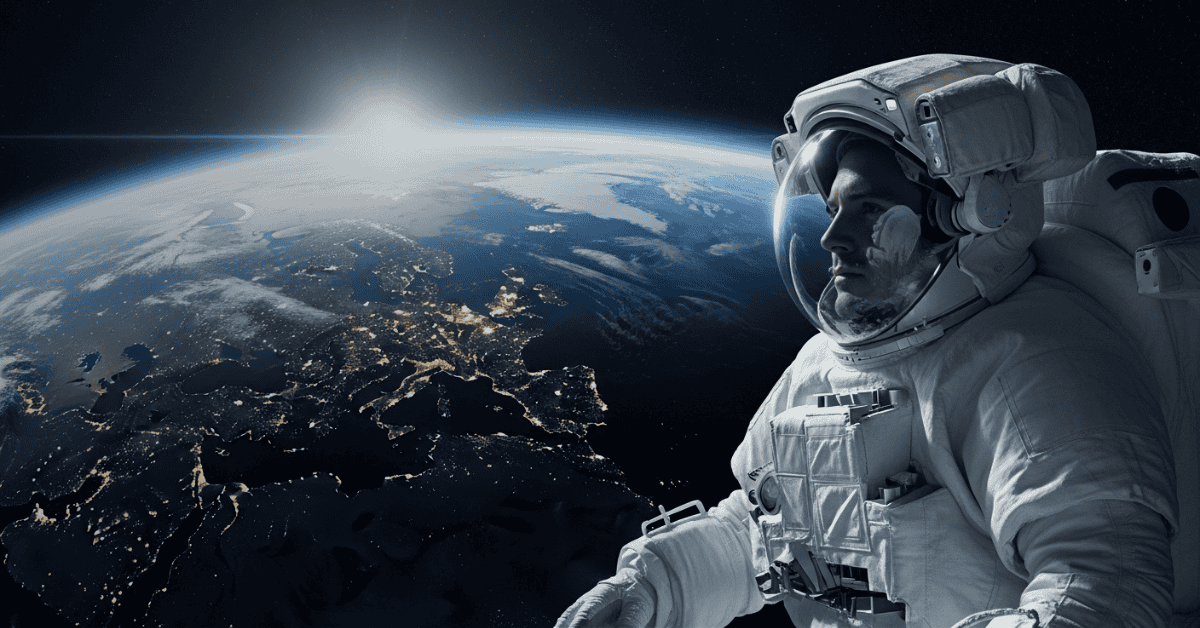
Floating 250 miles above Earth in the International Space Station, astronaut Kate Rubins gazed through the cupola window and witnessed something that changed her forever. The thin blue line separating our planet from the infinite black of space appeared impossibly fragile—no thicker than a contact lens held at arm’s length.
This breathtaking view from space has transformed how astronauts see our planet. More than just a beautiful sight, it represents a profound shift in consciousness that space travelers call the “overview effect.” Now, as humanity faces unprecedented environmental challenges, these cosmic messengers are sharing urgent warnings about the fragility of our only home.
The View That Changes Everything
The overview effect was first described by space philosopher Frank White in 1987. This psychological phenomenon occurs when astronauts see Earth from space and experience a cognitive shift in awareness about our planet’s place in the universe.
Astronaut Nicole Stott, who spent 104 days in space, describes the experience as life-altering. “You realize that everything you’ve ever known exists on this beautiful, fragile sphere suspended in the blackness,” she explains. The borders that divide nations disappear completely. The atmosphere appears as a gossamer-thin shell protecting all life below.
This perspective shift isn’t just emotional—it’s deeply practical. Astronauts return to Earth as some of our most passionate environmental advocates, armed with a unique understanding of planetary systems that most humans never experience.
Messages From the Cosmic Frontier
Today’s astronauts are witnessing changes to Earth’s systems in real-time from their orbital vantage point. The view is increasingly alarming.
Commander Chris Hadfield, who commanded the International Space Station, has documented dramatic changes during his missions. “You can see the scars of deforestation, the brown plumes of pollution, and the retreat of glaciers with startling clarity,” he reports. These observations aren’t abstract statistics—they’re visible transformations happening on a planetary scale.
Astronaut Alexander Gerst shared particularly striking images of Hurricane Florence in 2018, calling it a reminder of “what we’re doing to our planet.” From space, extreme weather events appear as massive, swirling systems that dwarf entire continents, revealing the awesome power of Earth’s changing climate systems.
The space station’s orbit takes it over every part of Earth every 90 minutes. This constant global surveillance provides astronauts with an unparalleled perspective on environmental changes. They witness seasonal shifts, track storm systems, and observe the delicate interplay between atmosphere, oceans, and land masses that sustains all life.
Scientific Evidence From Above
Space-based observations have revolutionized our understanding of Earth’s environmental health. NASA’s Earth Observing System satellites continuously monitor everything from ice sheet thickness to atmospheric greenhouse gas concentrations.
Data from these orbital platforms reveals troubling trends. Arctic sea ice is declining at a rate of 13 percent per decade. Global temperatures have risen by 1.1 degrees Celsius since the late 1800s. Carbon dioxide levels in the atmosphere have reached their highest point in over 3 million years.
Astronaut Scott Kelly, who spent nearly a year in space, witnessed these changes firsthand. “You can see how thin our atmosphere really is,” he observed. “It’s this incredibly thin layer that protects us from the vacuum and radiation of space. When you see pollution or changes to that atmosphere, you realize how precious and vulnerable it really is.”
These space-based observations provide crucial data for climate scientists. The European Space Agency’s Copernicus program uses satellite data to track environmental changes across the globe. This information helps researchers understand complex Earth systems and predict future changes with greater accuracy.
The Fragile Oasis Effect
Perhaps the most powerful message from astronauts concerns Earth’s isolation in space. Our planet appears as a solitary oasis suspended in an endless cosmic desert, with no backup plan and nowhere else to go.
This realization hits astronauts with profound force. Mae Jemison, the first African-American woman in space, describes Earth as “a living, breathing organism” when viewed from space. The interconnectedness of all Earth’s systems becomes immediately apparent from this cosmic perspective.
Water cycles are visible as clouds form and dissipate across continents. Ocean currents appear as rivers of different colored water flowing through the seas. The thin green line of vegetation that supports terrestrial life is clearly visible, emphasizing how narrow the habitable zone really is.
Astronauts report that national boundaries seem meaningless from space. Environmental problems don’t respect borders—pollution, climate change, and ecosystem degradation affect the entire planet. This perspective reinforces that environmental challenges require global cooperation and unified action.
Lessons for Life on Spaceship Earth
The astronaut’s perspective offers crucial insights for addressing our environmental crisis. Their warnings emphasize three key themes that could guide our response to planetary challenges.
First, Earth’s life-support systems are interconnected and finite. Just as astronauts must carefully manage resources on the space station, humanity must learn to live within planetary boundaries. Waste must be minimized, resources must be recycled, and energy must be used efficiently.
Second, there’s no backup planet. Unlike science fiction scenarios, we cannot simply move to another world if we damage Earth beyond repair. Mars is too hostile, other planets are too distant, and space colonies remain in the realm of speculation.
Third, cooperation is essential for survival. On the space station, astronauts from different nations work together seamlessly because their lives depend on it. Similarly, environmental challenges require unprecedented international collaboration and shared responsibility.
Technology and Hope From Space
Despite their warnings, astronauts also bring messages of hope. Space technology is already helping address environmental challenges on Earth.
Satellite monitoring systems track deforestation in real-time, enabling rapid responses to illegal logging. GPS systems optimize transportation routes, reducing fuel consumption and emissions. Weather satellites provide early warnings for extreme weather events, saving countless lives.
Innovations developed for space missions are finding applications in sustainable technology. Solar panel efficiency improvements, water recycling systems, and closed-loop life support technologies all have terrestrial applications for creating more sustainable communities.
Astronaut Peggy Whitson, who holds the record for most time spent in space by an American, believes that the space program provides both warnings and solutions. “Space teaches us to think differently about resources and sustainability,” she explains. “These lessons are exactly what we need to apply on Earth.”
The Overview Effect Goes Viral
Social media has amplified the astronaut’s message to unprecedented audiences. Spectacular images from space, shared instantly with millions of followers, are spreading the overview effect beyond the small community of space travelers.
Astronaut Chris Hadfield’s Twitter account reached millions during his space station mission. His photos and videos of Earth from space generated widespread interest in environmental issues and space exploration. This social media presence has created a new form of environmental advocacy from orbit.
The impact extends beyond simple awareness. Studies show that people who view Earth from space imagery report increased environmental concern and pro-environmental behavior. Virtual reality experiences that simulate the overview effect are being used in classrooms and environmental education programs worldwide.
A Call to Action From the Cosmos
The astronauts’ warning is clear and urgent. Earth’s environmental systems are changing rapidly, and the window for effective action is narrowing. However, their message also carries profound hope and inspiration.
From space, Earth appears as a unified whole—a beautiful, living world that deserves protection and care. The artificial divisions that separate us seem insignificant compared to our shared dependence on this remarkable planet.
As astronaut Mae Jemison observed, “The Earth we share unites us in a way that transcends any other.” The overview effect reminds us that we’re all passengers on Spaceship Earth, traveling together through the cosmos on this extraordinary journey called life.
The question now is whether we can learn to see our planet through an astronaut’s eyes before it’s too late. Our future depends on embracing the perspective of those who have seen Earth as it truly is—a precious, fragile oasis that deserves our deepest respect and most careful protection.
Sources
• NASA Earth Observatory: Earth from Space imagery and climate data (2023) • White, Frank. “The Overview Effect: Space Exploration and Human Evolution” (1987) • European Space Agency Copernicus Climate Change Service: Global temperature and ice data (2024)
• International Space Station Research & Science Office: Astronaut Earth observation studies (2023) • National Geographic: “The Overview Effect” documentary interviews (2022) • NASA Goddard Institute for Space Studies: Global climate monitoring reports (2024) • Journal of Environmental Psychology: Studies on overview effect and environmental behavior (2021) • Smithsonian National Air and Space Museum: Astronaut testimony archives (2023)
Disclaimer: This article is for informational purposes only and presents current scientific understanding of climate change and environmental issues. Readers should consult peer-reviewed scientific sources and environmental organizations for the most current research and policy recommendations.