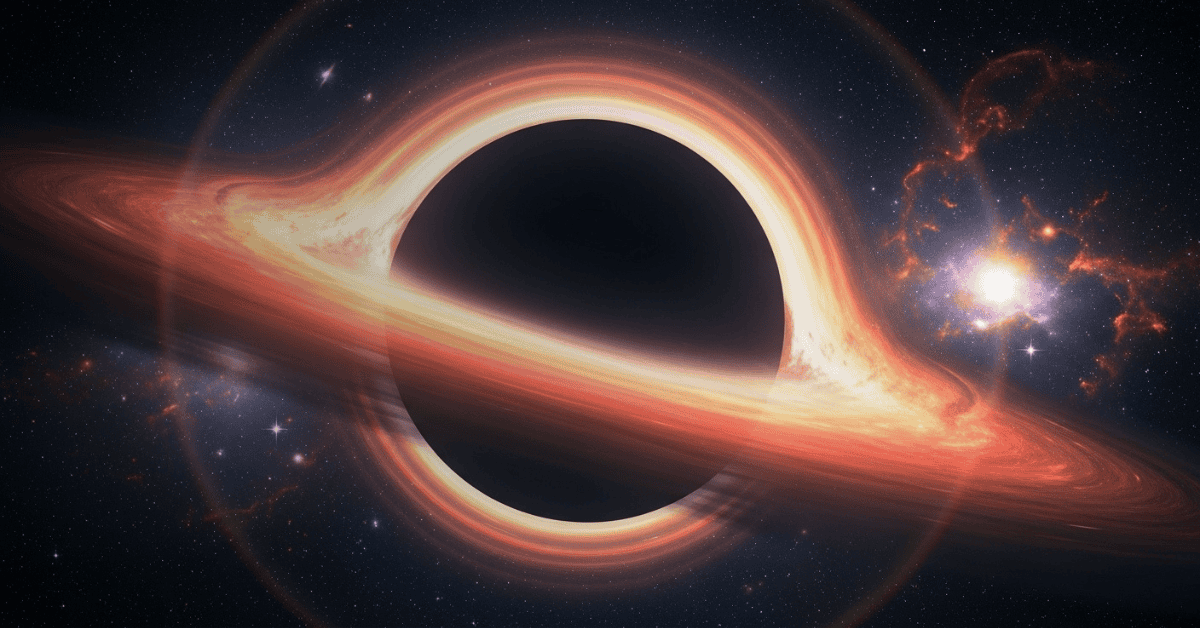
The most detailed gravitational wave signal ever captured reveals the violent dance of cosmic giants, proving decades-old predictions about the universe’s most mysterious objects.
The Cosmic Bell That Rang Across Space-Time
In the depths of space, 1.3 billion light-years from Earth, two titanic black holes spiraled toward each other at unimaginable speeds. Each possessed the mass of dozens of suns, yet occupied regions smaller than major cities. When they finally collided in a cataclysmic embrace, they sent ripples through the very fabric of space-time that would eventually reach our planet in January 2025.
This cosmic collision, detected by scientists and designated GW250114, has delivered the clearest evidence yet that Albert Einstein and Stephen Hawking were right about some of the universe’s most fundamental laws. The discovery represents a milestone in our understanding of black holes and validates theories that have guided physics for more than half a century.
The Quest to Understand Black Holes
Black holes have captivated scientists since Karl Schwarzschild first described them mathematically in 1916, shortly after Einstein published his theory of general relativity. These cosmic monsters represent the ultimate victory of gravity over matter, where stellar cores collapse into regions so dense that not even light can escape their gravitational pull.
For decades, physicists could only theorize about black hole properties. Einstein himself doubted these objects actually existed in nature. Stephen Hawking later proposed revolutionary ideas about black hole behavior in the 1970s, including his famous area theorem. Meanwhile, mathematician Roy Kerr developed equations in 1963 showing that spinning black holes could be described by just two characteristics: mass and rotation rate.
The breakthrough came in 2015 when the Laser Interferometer Gravitational-Wave Observatory (LIGO) first detected gravitational waves from colliding black holes. This discovery opened an entirely new window into the cosmos, allowing scientists to “hear” these violent events as they create ripples in space-time itself.
A Perfect Storm of Science
The January 2025 detection proved exceptional for several reasons. The merger created a final black hole with 63 times the mass of our sun, spinning at 100 revolutions per second. More importantly, LIGO’s upgraded instruments captured the entire event with unprecedented clarity, from the initial approach through the final “ringing” as the newly formed black hole settled into stability.
Maximiliano Isi of Columbia University and the Flatiron Institute, who led the analysis, describes this as “the clearest view yet of the nature of black holes.” The team could isolate and study the merger’s final milliseconds, when the combined black hole emitted its characteristic gravitational wave signature.
This detailed observation allowed researchers to test two fundamental predictions that had remained unproven for decades.
Einstein’s Simplicity Confirmed
The first breakthrough confirmed Kerr’s mathematical description of black holes. Despite their mind-bending physics, black holes are surprisingly simple objects. The new measurements showed that the merged black hole behaves exactly as predicted by Kerr’s equations, describable by just its mass and spin.
This simplicity contrasts sharply with everyday objects, which require countless variables to describe completely. A basketball needs measurements of size, weight, material composition, temperature, and surface texture. But a black hole with the mass of billions of suns can be fully characterized by two numbers alone.
Scientists verified this by analyzing the gravitational waves’ frequency and duration. Like a bell struck with different forces, black holes of varying masses and spins produce distinct gravitational wave “tones.” The measurements matched theoretical predictions with remarkable precision.
Hawking’s Area Theorem Vindicated
The second major confirmation involved Stephen Hawking’s area theorem from 1971. This principle states that a black hole’s event horizon—the boundary beyond which nothing can escape—can only grow larger over time, never smaller.
By measuring the event horizons before and after the merger, researchers confirmed that the final black hole’s surface area exceeded the combined areas of its parent black holes. The merged object possessed an event horizon covering roughly 400,000 square kilometers, validating Hawking’s prediction.
This confirmation carries profound implications beyond black hole physics. The area theorem connects to fundamental thermodynamic principles, suggesting that black hole horizons behave like entropy measures in physics. This relationship hints at deep connections between gravity, quantum mechanics, and the nature of information itself.
The Technology Behind the Discovery
LIGO achieves its remarkable sensitivity through laser interferometry, measuring changes in space-time geometry as small as 1/10,000th the width of a proton. The observatory uses perpendicular laser beams traveling down four-kilometer arms. When gravitational waves pass through Earth, they stretch space in one direction while compressing it in another, creating tiny changes in the laser travel times.
The 2025 detection benefited from decade-long improvements in LIGO’s instruments and analysis techniques. Enhanced vibration isolation, better laser systems, and sophisticated data processing algorithms all contributed to the exceptional signal quality that made these tests possible.
Three major gravitational wave observatories now operate worldwide: LIGO in the United States, Virgo in Italy, and KAGRA in Japan. Their combined observations provide multiple perspectives on cosmic events, improving measurement accuracy and expanding detection capabilities.
Implications for Future Physics
These confirmations represent more than academic victories. They validate the mathematical frameworks that physicists use to understand extreme environments throughout the universe. Black holes serve as natural laboratories for testing physics under conditions impossible to recreate on Earth.
The area theorem’s confirmation particularly excites researchers because it suggests deep connections between gravity and thermodynamics. Understanding these relationships could lead to breakthroughs in quantum gravity theory, which aims to unify Einstein’s relativity with quantum mechanics—physics’ greatest unsolved puzzle.
As Isi notes, “It’s really profound that the size of a black hole’s event horizon behaves like entropy.” This behavior provides mathematical tools for probing the fundamental nature of space and time itself.
A New Era of Cosmic Archaeology
The success of gravitational wave astronomy opens unprecedented possibilities for studying the universe’s most extreme phenomena. Future detector upgrades will increase sensitivity by factor of ten, enabling observations of more distant and subtle events.
Scientists anticipate detecting thousands of black hole mergers in coming decades, creating a comprehensive catalog of these objects across cosmic history. Each detection adds pieces to our understanding of how black holes form, evolve, and influence their surroundings.
Beyond black holes, gravitational wave observatories may detect other exotic phenomena: neutron star collisions, primordial black holes from the early universe, or even signatures from cosmic strings—theoretical defects in space-time itself.
The Sound of Space-Time
Perhaps most remarkably, these discoveries transform black holes from mathematical abstractions into observable realities. We can now “listen” to the universe’s most violent events as they create literal music in the fabric of space-time.
Will Farr, co-leader of the research team, emphasizes that “listening to the tones emitted by these black holes is our best hope for learning about the properties of the extreme space-times they produce.”
Each gravitational wave detection adds new instruments to this cosmic symphony, revealing the universe’s hidden dynamics through sound rather than light. As detector technology advances, we’ll hear fainter and more distant cosmic concerts, extending our acoustic reach across billions of light-years.
The January 2025 black hole merger represents just the beginning of this new era in astronomy. Einstein and Hawking’s theories have passed their most rigorous tests yet, but many mysteries remain. What happens inside black holes? How do they connect to quantum mechanics? Can we detect the universe’s first black holes?
As we tune our instruments to hear space-time’s whispers, each new detection brings us closer to answering humanity’s deepest questions about the cosmos and our place within it.
Sources
• Isi, M., et al. “Direct Observation of Black Hole Merger Ringdown.” Physical Review Letters, 2025.
• LIGO-Virgo-KAGRA Collaboration. “Gravitational Wave Detection GW250114.” Physical Review Letters, September 2025.
• MIT News. “Physicists observationally confirm Hawking’s black hole theorem for the first time.” Massachusetts Institute of Technology, 2021.
• Simons Foundation. “Ringing Black Hole Confirms Einstein and Hawking’s Predictions.” September 2025.
• Scientific American. “Best-Yet Measurement of Merging Black Holes Confirms Einstein, Hawking.” September 2025.
• NASA Goddard Space Flight Center. “Black Hole Physics and Gravitational Wave Detection.” 2024.
• Physical Review Letters. “Gravitational Wave Studies of Black Hole Properties.” Various Issues, 2021-2025.
Disclaimer
This article is for informational purposes only and should not replace professional scientific advice. The research described represents ongoing scientific investigations, and future studies may refine or modify these findings.