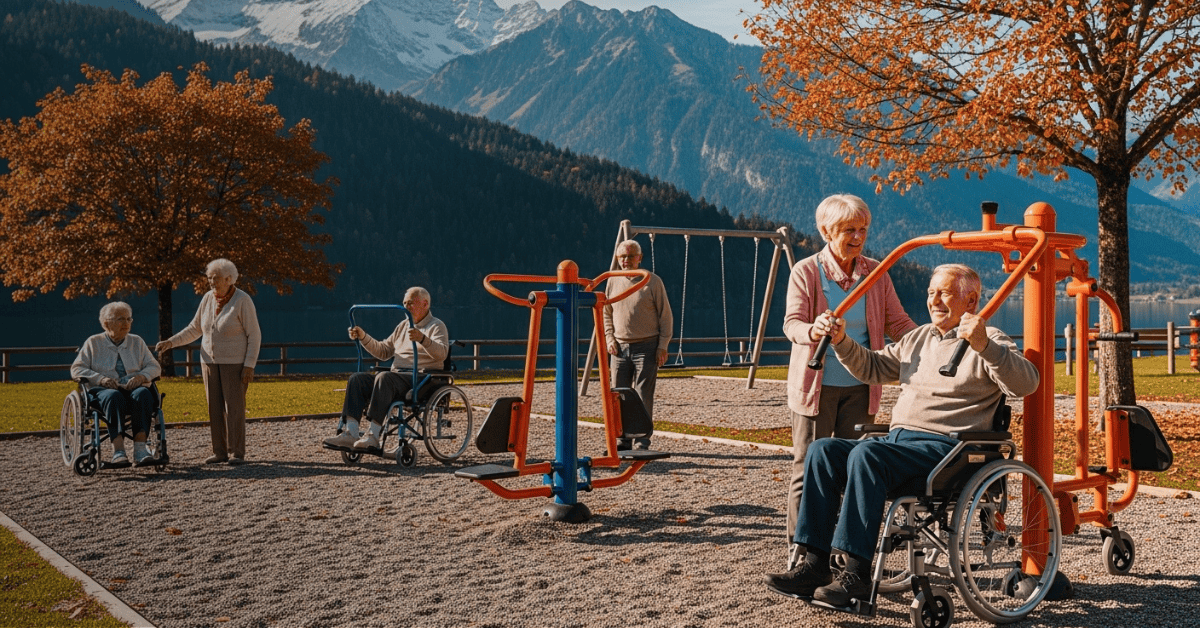
In Basel, Switzerland, 78-year-old Ernst Müller grips the handles of a specially designed elliptical trainer and begins his morning routine. Around him, other seniors stretch on outdoor balance beams, practice coordination on wobble boards, and laugh together while navigating obstacle courses designed specifically for aging bodies. This isn’t a traditional gym or rehabilitation center—it’s a senior playground, part of Switzerland’s revolutionary approach to aging that’s transforming how the world thinks about exercise, community, and growing older.
The Birth of a Movement
Switzerland pioneered the concept of senior playgrounds in the early 2000s, responding to a demographic shift that would reshape European society. By 2020, nearly 20% of Switzerland’s population was over 65, making it one of the oldest countries in Europe.
Traditional playgrounds served children’s developmental needs through climbing, swinging, and balancing. Swiss urban planners wondered: why shouldn’t older adults have equipment designed for their specific physical requirements?
The first senior playground opened in Zurich in 2003. Unlike children’s playgrounds with bright primary colors and towering structures, these spaces featured earth tones, lower equipment, and clear instructional signage. The Swiss Federal Office of Public Health endorsed the initiative, recognizing its potential to address rising healthcare costs through preventive exercise.
Engineering for Aging Bodies
Senior playground equipment differs dramatically from traditional fitness machines. Engineers collaborate with gerontologists and physical therapists to create devices that address age-related physical changes while remaining engaging and social.
Balance training stations help combat the declining proprioception that affects 35% of adults over 70. These platforms feature varying textures and stability levels, allowing users to progress gradually while reducing fall risk—a leading cause of injury among seniors.
Resistance equipment uses body weight rather than heavy weights, protecting aging joints while building functional strength. Seated rowing machines accommodate users with mobility limitations, while standing versions challenge those seeking greater intensity.
Flexibility stations incorporate gentle stretching apparatus designed for reduced range of motion. These devices help maintain joint mobility that typically decreases by 6% per decade after age 55.
A Social Prescription for Loneliness
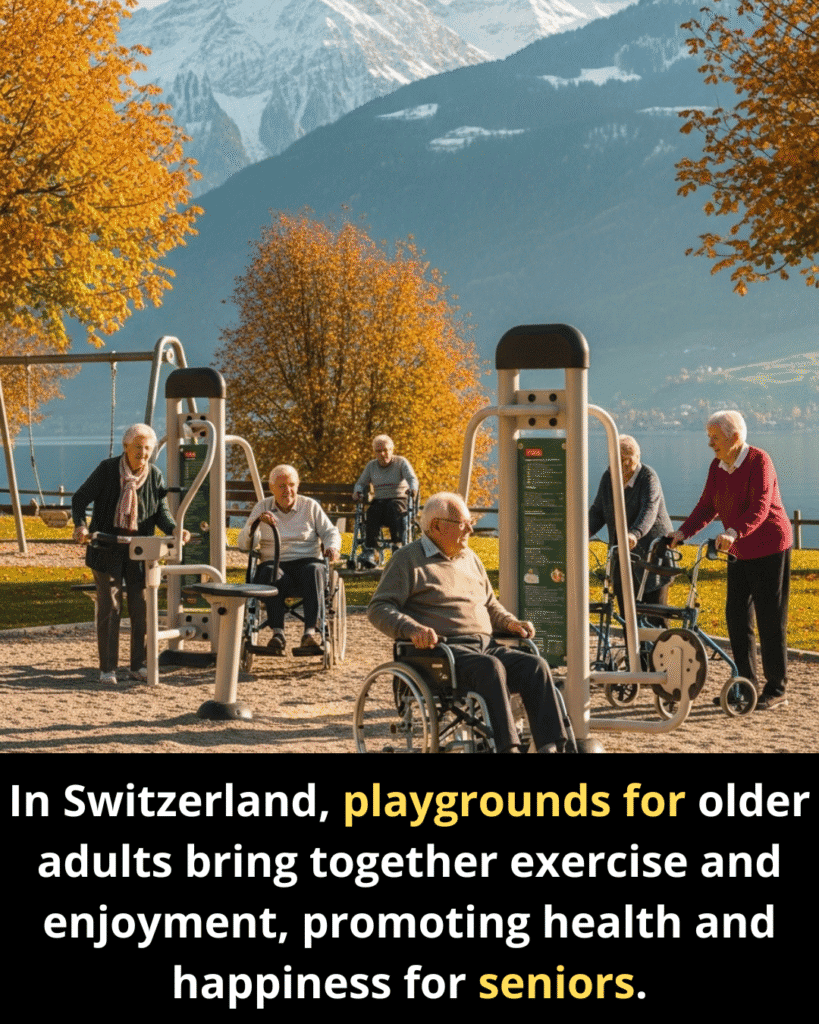
The genius of senior playgrounds extends beyond physical benefits. Research from the University of Basel found that regular users reported 40% less loneliness compared to sedentary peers. The equipment naturally encourages interaction—users spot each other on balance beams, share exercise tips, and form workout groups.
Dr. Sandra Weber, a geriatric specialist at Zurich University Hospital, explains the phenomenon: “Exercise releases endorphins, but exercising together releases something more powerful—social connection. We’re treating isolation as seriously as we treat high blood pressure.”
Many playgrounds feature benches positioned strategically around equipment, creating natural gathering spaces. Regular users develop informal communities, arriving at similar times and checking on absent friends. These relationships often extend beyond the playground into broader social networks.
Switzerland’s Aging Innovation Laboratory
Switzerland operates over 400 senior playgrounds nationwide, more per capita than any other country. Each installation costs between 50,000 and 150,000 Swiss francs, funded through municipal budgets and federal health initiatives.
The Swiss approach emphasizes accessibility and inclusion. Playgrounds feature wheelchair-accessible paths, equipment suitable for various ability levels, and clear multilingual instructions reflecting Switzerland’s linguistic diversity. Weather-resistant materials ensure year-round use, crucial in a country where outdoor exercise culture transcends seasonal limitations.
Swiss municipalities track usage data through electronic counters and regular surveys. Results show consistent daily use, with peak hours mirroring traditional gym patterns—early morning and early evening. Weekend usage remains high, suggesting recreational rather than merely therapeutic use.
The Science of Staying Young
Medical research validates what Swiss seniors experience daily. A 2023 study published in the Journal of Aging and Physical Activity followed 300 senior playground users for two years. Participants showed measurable improvements in balance, flexibility, and cardiovascular health compared to control groups.
More surprisingly, cognitive function improved among regular users. Dr. Klaus Zimmermann, the study’s lead researcher, attributes this to the dual-task nature of playground activities: “Users must coordinate movement while processing spatial information and social interaction. This challenges multiple brain systems simultaneously.”
Blood pressure readings decreased an average of 8 points systolic among participants who used playgrounds three times weekly. Depression scores, measured using standardized psychological assessments, improved by 25% over six months of regular use.
Global Adoption and Adaptation
Switzerland’s success sparked international interest. Germany installed over 200 senior playgrounds by 2022, while Austria, Finland, and the Netherlands launched pilot programs. Each country adapts the concept to local preferences and climate conditions.
Japan’s senior playgrounds incorporate traditional exercise movements like radio taiso, blending cultural familiarity with modern equipment design. Australia’s installations feature shade structures essential for outdoor exercise in intense sunlight.
The United States lags in adoption, with fewer than 50 senior playgrounds nationwide. Cultural attitudes toward aging and exercise, combined with different healthcare funding models, slow implementation despite demonstrated benefits.
Challenges and Controversies
Not everyone embraces senior playground culture. Some critics argue that age-segregated exercise perpetuates ageism rather than promoting intergenerational activity. Others question the cost-effectiveness compared to traditional gyms or community centers.
Weather dependency presents practical challenges. Swiss winters reduce usage despite hardy cultural attitudes toward outdoor activity. Some municipalities installed heated seating and wind barriers, while others promote indoor alternatives during harsh weather.
Maintenance costs exceed initial projections in many installations. Specialized equipment requires trained technicians for repairs, and liability insurance adds ongoing expenses that strain municipal budgets.
The Future of Aging in Motion
Switzerland’s senior playgrounds represent more than exercise equipment—they embody a philosophy that aging doesn’t mean retreating from active life. As global populations age, this Swiss innovation offers a model for maintaining physical and social health through accessible, community-based activity.
Emerging technologies promise even greater possibilities. Smart sensors could provide real-time feedback on exercise form and progress. Virtual reality installations might add cognitive challenges to physical activities. Intergenerational playground designs could bridge age gaps while serving diverse fitness needs.
The success of Switzerland’s senior playgrounds suggests that reimagining public spaces for aging populations isn’t just compassionate policy—it’s essential preparation for a world where staying active at 80 becomes as normal as learning to walk at 2. In Basel’s morning light, Ernst Müller completes his workout routine, schedules coffee with friends, and proves that play truly knows no age limit.
Sources
• Swiss Federal Office of Public Health. “Active Aging Through Outdoor Exercise: National Policy Report.” 2023. • University of Basel, Department of Geriatric Medicine. “Social Isolation and Exercise Intervention Study.” Journal of Community Health, 2022. • Weber, S., et al. “Physical Activity and Mental Health in Swiss Seniors.” Zurich University Hospital Press, 2023. • Zimmermann, K., et al. “Cognitive Benefits of Outdoor Exercise Equipment for Older Adults.” Journal of Aging and Physical Activity, 2023. • European Centre for Disease Prevention and Control. “Demographic Health Trends in Europe.” Stockholm, 2022. • Swiss Association of Municipalities. “Senior Playground Implementation and Usage Report.” Bern, 2023.
Disclaimer: This article is for informational purposes only and should not replace professional medical or fitness advice. Consult healthcare providers before beginning new exercise programs, especially for individuals with existing health conditions.