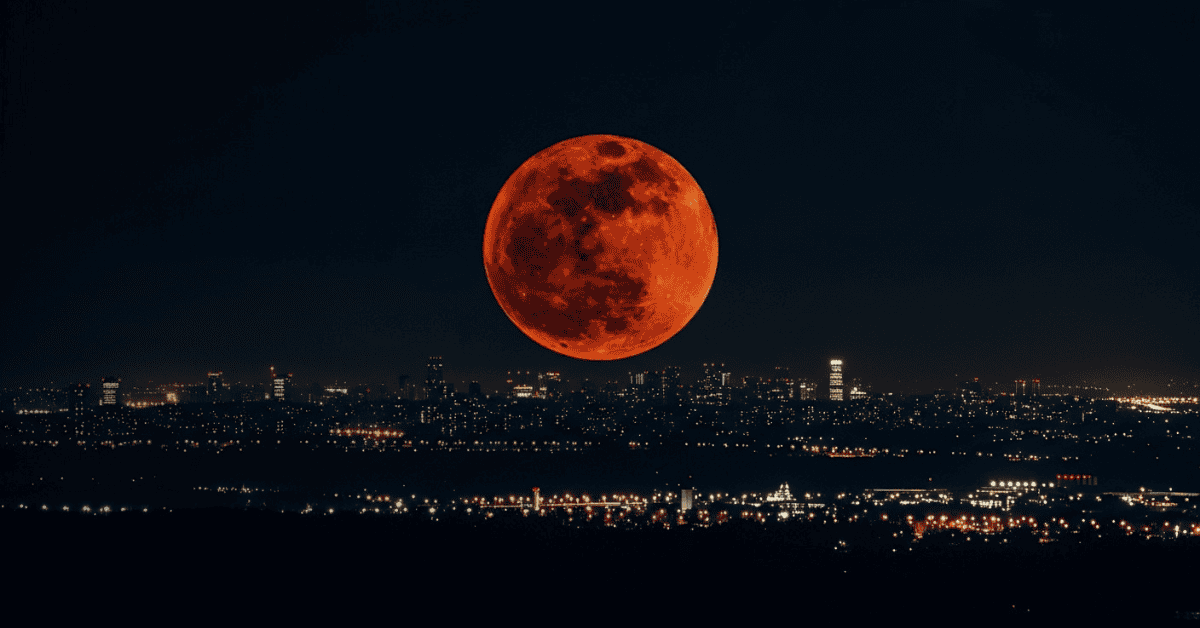
This weekend brings the longest total lunar eclipse since 2022, turning Earth’s natural satellite into a crimson orb visible to billions across four continents—but not everyone will witness this celestial spectacle.
The full moon will rise on the evening of September 7, 2025, carrying within it an ancient promise. As Earth’s shadow slowly engulfs its surface, our closest cosmic neighbor will transform from a brilliant silver disk into something far more mysterious—a blood-red sphere hanging in the darkness like a distant ember.
This total lunar eclipse represents one of nature’s most dramatic performances, and remarkably, an estimated 85 percent of the world’s population will have the opportunity to witness it, weather permitting. The event marks the final lunar eclipse of 2025 and the longest total eclipse visible from Earth since November 2022.
The Ancient Dance of Shadows
Throughout human history, the sight of a blood moon has stirred both wonder and fear. Ancient civilizations interpreted these crimson transformations as omens, divine battles, or celestial dragons devouring the moon. Today, we understand the elegant mechanics behind this phenomenon, yet the spectacle remains no less captivating.
The September 7-8 eclipse will maintain totality for an impressive 82 minutes, making it the longest-duration blood moon of the current decade. During this extended period, sunlight filtering through Earth’s atmosphere will bathe the moon in hues ranging from deep copper to brilliant orange-red.
The transformation occurs because Earth’s atmosphere acts like a cosmic lens. Blue light scatters away as sunlight passes through our planet’s atmospheric layers, while longer wavelengths of red and orange light bend around Earth’s edges to reach the lunar surface. This same phenomenon creates our daily sunrises and sunsets, painting the moon in familiar terrestrial colors.
A Global Viewing Experience
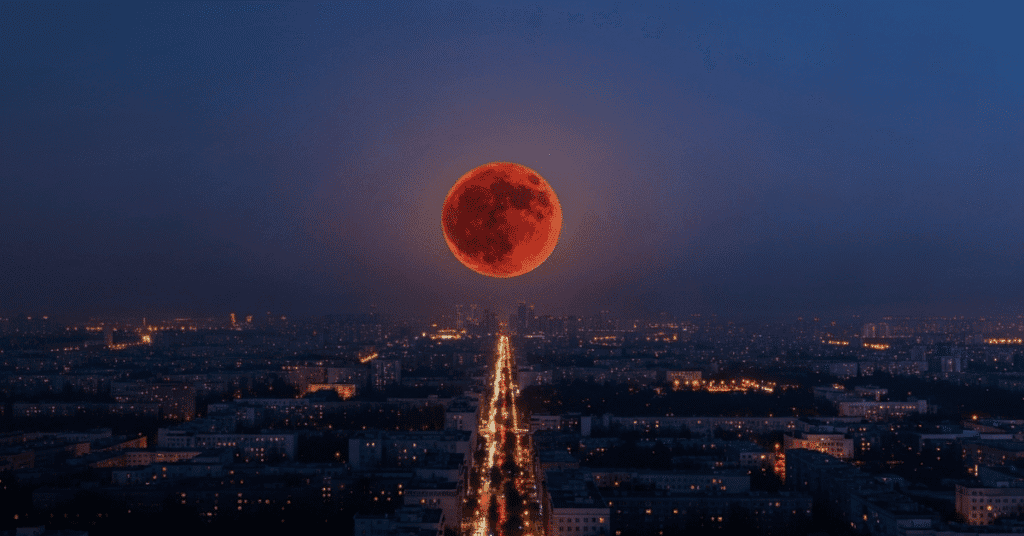
The eclipse’s path of visibility encompasses Australia, Asia, Africa, and Europe, offering viewing opportunities to approximately 85 percent of Earth’s population. However, the timing and quality of views vary dramatically by location.
Prime Viewing Locations
Observers in India, China, Russia, Australia, New Zealand, east Africa, and regions surrounding central Asia will experience the complete eclipse sequence. These fortunate locations will witness the moon’s gradual entry into Earth’s shadow, its transformation into a blood-red orb, and its eventual emergence back into full illumination.
The total eclipse phase begins at 17:30 GMT (1:30 p.m. EDT) and concludes at 18:52 GMT (2:52 p.m. EDT). For optimal viewing, observers need clear skies and the moon visible above their horizon during these crucial hours.
Partial Views and Moonrise Eclipses
UK observers will witness a particularly dramatic moonrise eclipse, with the blood moon appearing above the horizon already in its transformed state. Parts of eastern Europe will catch the eclipse’s final stages as the moon emerges from Earth’s shadow.
Unfortunately for some regions, geography works against this celestial showing. North and South America will miss the September eclipse entirely, as Earth itself blocks their view during the event. The timing places the eclipse during daytime hours for the Americas, making observation impossible.
The Science Behind the Spectacle
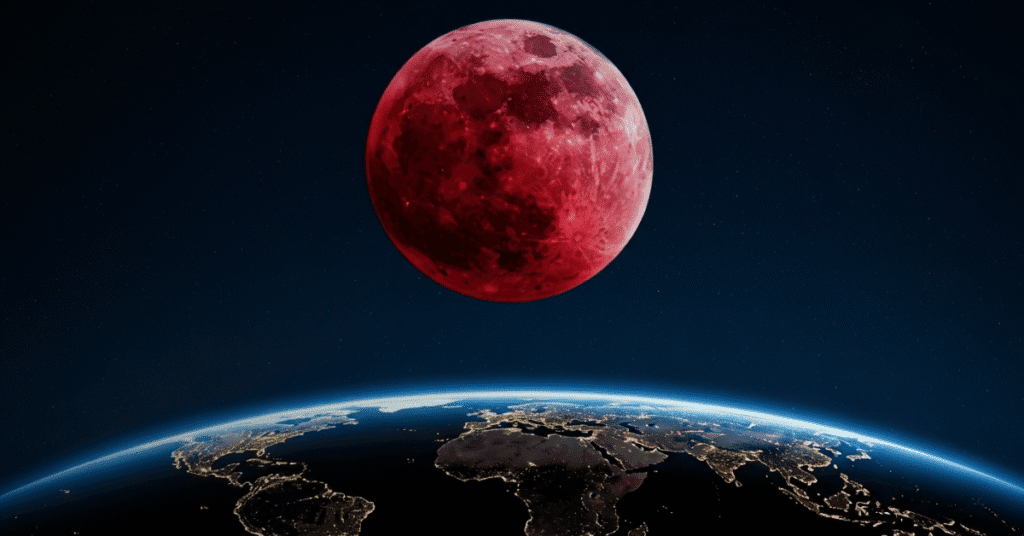
The September 7-8 eclipse belongs to Saros cycle 128, part of a predictable pattern that repeats every 18 years, 11 days, and 8 hours. This mathematical precision allows astronomers to calculate eclipses centuries into the future and helps explain why certain regions see multiple eclipses while others wait decades between viewings.
The full moon will appear in the constellation Aquarius the Water Bearer, positioned perfectly for Earth’s shadow to completely engulf it. The eclipse’s exceptional duration results from the moon’s path through the central portion of Earth’s shadow, maximizing the time spent in total darkness.
Unlike solar eclipses, which require special protective equipment, lunar eclipses present no viewing dangers. The blood moon can be safely observed with naked eyes, binoculars, or telescopes without risk of eye damage.
Cultural Connections Across Continents
This eclipse creates a shared experience spanning multiple continents and cultures. From Aboriginal Australian communities to Scandinavian astronomers, from Indian families gathering on rooftops to African students learning about celestial mechanics, the blood moon connects diverse populations through a common astronomical event.
Modern technology amplifies this connection. Live streams and social media will carry real-time images from prime viewing locations to regions where the eclipse remains invisible. Space agencies and observatories worldwide coordinate efforts to document and share the event, transforming a localized phenomenon into a global experience.
The eclipse also serves educational purposes across different time zones. As totality sweeps across continents, teachers and astronomers can use the event to demonstrate Earth’s rotation, explain atmospheric physics, and inspire new generations of space enthusiasts.
Planning Your Eclipse Experience
For those within the viewing zone, preparation enhances the experience significantly. Urban light pollution reduces eclipse visibility, so suburban or rural locations provide superior views. Weather forecasts become crucial as cloudy skies completely block lunar observations.
Photography enthusiasts should prepare camera settings in advance. The blood moon’s relatively dim illumination requires longer exposure times and higher ISO settings compared to normal full moon photography. Tripods stabilize equipment for sharp images during extended exposures.
International viewing parties and astronomy club gatherings offer community experiences around the eclipse. Many locations organize public viewing events with telescopes and expert commentary, making the phenomenon accessible to broader audiences.
Looking Beyond This Weekend
While North America misses this eclipse, the wait for the next visible blood moon lasts only 177 days, arriving in March 2026. This relatively short interval demonstrates how eclipse visibility patterns shift across Earth’s surface over time.
The September eclipse represents part of ongoing lunar exploration missions and scientific studies. Researchers use eclipse conditions to study Earth’s atmosphere by analyzing how our planet’s air layers filter sunlight. These observations contribute to climate science and atmospheric research programs.
Future eclipse predictions extend centuries ahead, ensuring that tomorrow’s astronomers can plan observations and research projects well in advance. Each eclipse adds data points to our understanding of Earth-moon dynamics and atmospheric behavior.
As you gaze upward this weekend—whether witnessing the blood moon directly or following along through digital windows—remember that you’re participating in humanity’s oldest scientific tradition: watching the skies and wondering at the cosmic mechanics that govern our celestial neighborhood. The dance continues, shadows shift, and somewhere above, the moon awaits its next transformation.
Sources
• NASA Goddard Space Flight Center Eclipse Predictions (2025) • Time and Date Eclipse Database – September 7-8, 2025 Total Lunar Eclipse • Live Science Space and Astronomy Division (2025) • AccuWeather Space Weather Division (2025) • BBC Sky at Night Magazine Eclipse Coverage (2025) • Earth Sky Astronomy Resource Center (2025) • Space.com Lunar Eclipse Guide (2025) • Star Walk Space App Eclipse Database (2025)