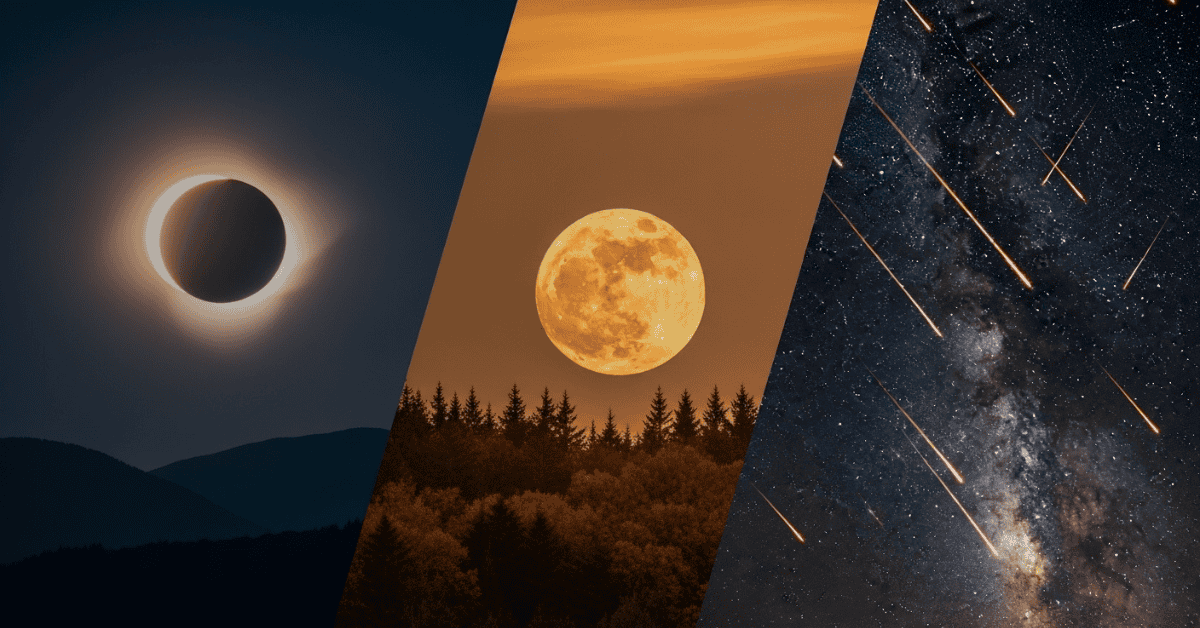
September 2025 delivers a celestial triple feature that transforms Earth’s nighttime stage into nature’s grandest theater, showcasing two rare eclipses and the seasonal balance of autumn’s arrival.
A Month Written in Starlight
Picture this: a crimson moon hanging in the darkness like a ruby suspended in velvet, followed by the sun’s mysterious dance with shadows, all crowned by the precise moment when day and night stand in perfect balance. This is September 2025, a month that astronomy enthusiasts will remember for decades.
The universe has aligned its celestial clockwork to deliver three spectacular events within just weeks of each other. September 2025 is packed with exciting astronomical events, including a total lunar eclipse, a partial solar eclipse, Saturn at opposition, lunar occultations of Venus and the Pleiades, and the September equinox.
These aren’t random cosmic coincidences. They represent the intricate ballet of our solar system, where predictable orbital mechanics create windows of wonder that connect us to the broader universe.
The Blood Moon’s Ancient Story
Throughout history, civilizations have interpreted lunar eclipses as omens, battles between celestial gods, or dragons devouring the moon. The Maya tracked these events with mathematical precision, while ancient Chinese astronomers developed elaborate theories about cosmic dragons.
Today, we understand the elegant physics behind these phenomena. A lunar eclipse occurs when Earth positions itself directly between the sun and moon, casting our planet’s shadow across the lunar surface. But the moon doesn’t disappear completely during totality—instead, it glows with an ethereal red hue.
This crimson transformation happens because Earth’s atmosphere acts like a lens, bending sunlight around our planet’s edges. Blue light scatters away, while longer red wavelengths continue their journey to paint the moon in shades ranging from deep copper to brilliant orange.
Indigenous cultures worldwide have recognized this celestial rhythm for millennia, weaving eclipse cycles into their calendars and spiritual practices with remarkable accuracy.
September’s Celestial Spectacle Unfolds
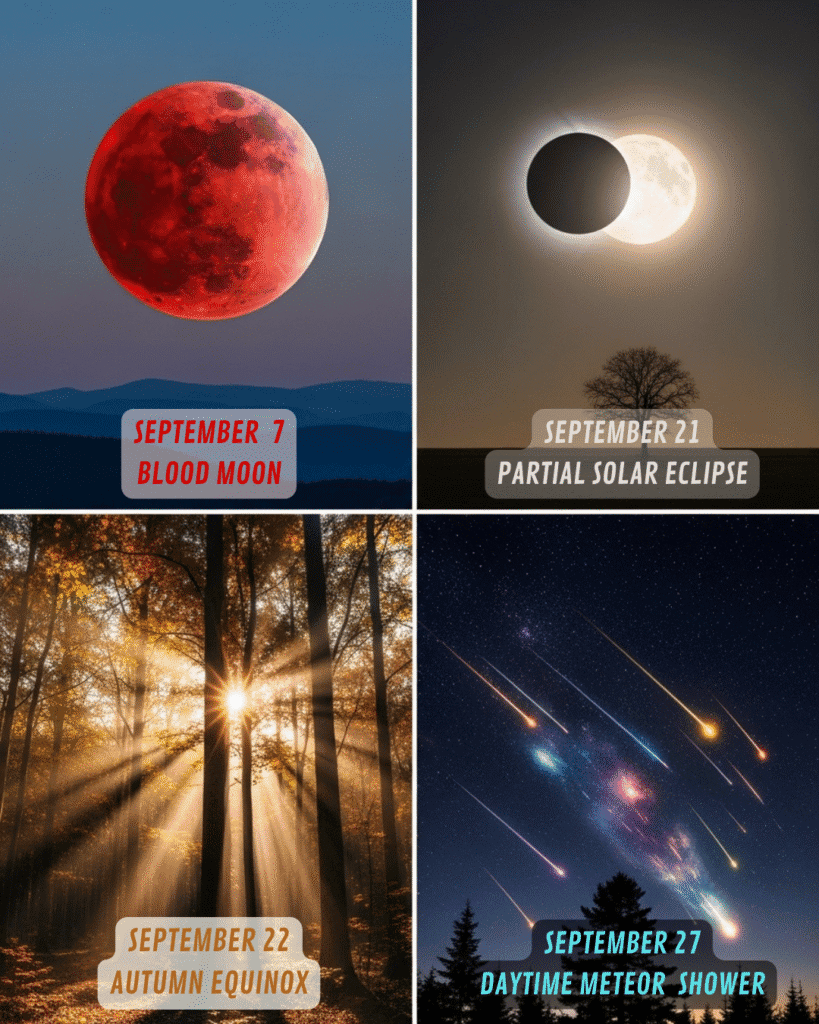
The month’s astronomical drama begins on September 7, 2025, when Earth slides between the sun and moon, creating a rare total lunar eclipse, also called the Blood Moon. This event marks the peak of September’s full Corn Moon, a traditional name reflecting harvest season’s arrival.
The celestial event will begin at 8:57 pm and peak between 11:00 pm and 12:22 am. For observers in the visibility zone, this means several hours to witness the moon’s gradual transformation from its familiar silver glow to a haunting red orb.
The eclipse’s path creates a viewing corridor that stretches across multiple continents. This total lunar eclipse will be visible in India and extends into parts of Europe, Africa, eastern regions, offering billions of people front-row seats to this cosmic theater.
Unlike solar eclipses, which require special viewing equipment and occur along narrow paths, lunar eclipses present themselves safely to the naked eye across entire hemispheres. No special glasses or telescopes are needed—just clear skies and curiosity.
Two weeks later, on Sept. 21, nature delivers an encore performance with a partial solar eclipse. This event creates what astronomers call an “equinox eclipse” because it occurs just hours before the September equinox. However, this eclipse will only be visible to those in New Zealand, Antarctica, and the south Pacific Ocean.
The timing makes this solar eclipse particularly rare. A partial solar eclipse is taking place just hours before the equinox flips Earth’s seasons in September 2025. While most humans won’t witness this event directly, it represents a fascinating alignment of celestial mechanics.
Finally, on September 22, Earth reaches the September equinox. On this day the Sun will illuminate the Northern and Southern Hemispheres equally, and day and night will be roughly the same length. This moment occurs at precisely 18:20 GMT, marking autumn’s official arrival in the Northern Hemisphere.
The equinox represents more than just a calendar date. It’s a cosmic checkpoint where our planet’s 23.5-degree axial tilt creates equal illumination between hemispheres. Ancient cultures built monuments like Stonehenge and Chichen Itza to capture these precise moments, understanding their significance for agriculture, navigation, and spiritual practices.
Saturn’s Golden Opposition
September also showcases Saturn at opposition, when the ringed planet reaches its closest approach to Earth for the year. It will be brighter than any other time of the year and will be visible all night long. This is the best time to view and photograph Saturn and its moons.
Opposition occurs when Earth positions itself directly between the sun and an outer planet, creating optimal viewing conditions. Saturn appears at its largest and brightest, rising at sunset and remaining visible throughout the night.
A medium-sized or larger telescope will allow you to see Saturn’s rings and a few of its brightest moons. This includes Titan, Saturn’s largest moon, which harbors lakes of liquid methane and a thick atmosphere that intrigues astrobiologists.
For amateur astronomers, Saturn’s opposition provides an annual opportunity to observe details usually hidden by distance and atmospheric interference. The planet’s magnificent ring system becomes clearly defined, revealing gaps like the Cassini Division and showcasing the rings’ complex structure.
Connecting Earth to Cosmos
These September events illustrate fundamental principles that govern our solar system and beyond. The same gravitational forces creating these eclipses and planetary alignments operate throughout the universe, shaping galaxy formations and stellar evolution.
Lunar eclipses occur roughly twice per year somewhere on Earth, but the visibility pattern creates regional cycles spanning decades. Some locations experience frequent eclipses while others wait years between events. This variability results from the complex interaction between Earth’s rotation, the moon’s elliptical orbit, and our planet’s axial tilt.
This total lunar eclipse will be visible in India, allowing researchers to get insights into Earth’s atmospheric dust and aerosols via its red hue. Scientists use eclipse observations to study atmospheric conditions, measuring how particles and gases affect light transmission. These studies contribute to climate research and air quality monitoring.
The September equinox also connects local seasons to global climate patterns. As Northern Hemisphere temperatures begin cooling, Southern Hemisphere locations prepare for spring warming. This seasonal shift drives migration patterns, agricultural cycles, and weather systems that affect billions of people worldwide.
Saturn’s opposition demonstrates how planetary motions create predictable observation windows throughout our solar system. The same principles allow astronomers to calculate optimal launch windows for space missions and predict planetary positions centuries into the future.
A Window Into Wonder
September 2025 represents more than just a collection of astronomical events. These celestial performances connect us to the vast cosmos surrounding our tiny blue world, reminding us that Earth participates in an intricate cosmic dance spanning billions of years.
Each eclipse, equinox, and planetary opposition offers opportunities for scientific discovery and personal wonder. Professional astronomers gather data that advances our understanding of orbital mechanics, atmospheric physics, and planetary evolution. Meanwhile, casual observers experience moments of awe that spark lifelong interests in science and space exploration.
The precise timing of these events also demonstrates the mathematical beauty underlying natural phenomena. Ancient civilizations developed sophisticated astronomical knowledge by carefully tracking these cycles, laying foundations for modern science and navigation.
As September’s astronomical theater unfolds, observers worldwide will share experiences that transcend cultural and geographical boundaries. The same red moon that amazes viewers in Mumbai will captivate families in Cairo and inspire students in London, creating global moments of shared wonder.
These events remind us that despite our busy terrestrial concerns, we remain passengers on a planet hurtling through space, orbiting a star in a galaxy containing billions of other worlds. September 2025’s sky show invites us to look up, step outside our daily routines, and reconnect with the magnificent universe that surrounds us.
Sources
• NASA Jet Propulsion Laboratory – “What’s Up: September 2025 Skywatching Tips from NASA” (2025) • Royal Observatory Greenwich – “Space and astronomy highlights 2025” (2025) • EarthSky – “Total lunar eclipse of the full Corn Moon September 7, 2025” (2025) • TimeAndDate.com – “Total Lunar Eclipse on September 7–8, 2025” (2025) • Sea and Sky – “Astronomy Calendar of Celestial Events 2025” (2025) • The Planetary Society – “Calendar of space events 2025” (2025) • Star Walk – “Astronomical Events in September 2025 – 2 Eclipses, Equinox & More” (2025) • Live Science – “Equinox eclipse 2025: Where September’s rare solar eclipse will be visible” (2025)
Disclaimer
This article is for informational purposes only and should not replace professional astronomical or scientific advice. Eclipse viewing safety guidelines should be followed when observing solar eclipses.