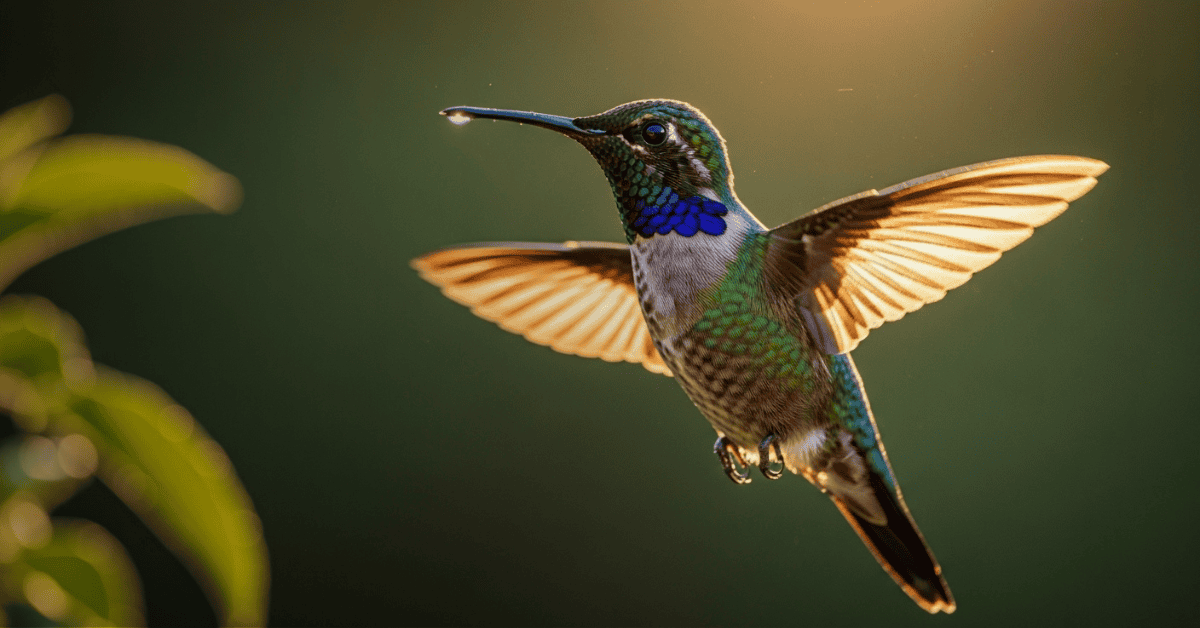
A ruby-throated hummingbird hovers before a crimson trumpet flower, its wings beating 80 times per second in a blur invisible to human eyes. In the span of a single heartbeat, this tiny creature—weighing less than a nickel—burns more energy per gram than a sprinting cheetah. Yet somehow, this biological paradox not only survives but thrives across two continents, defying every rule about what should be possible for such a small warm-blooded animal.
The physics of hummingbird flight alone should make their existence impossible. Their metabolic demands are so extreme that they live perpetually on the edge of starvation, just hours away from death without constant feeding.
The Physics-Defying Fliers
Hummingbirds represent one of nature’s most audacious experiments in miniaturization. The bee hummingbird of Cuba, the world’s smallest bird, measures just 2.25 inches from beak to tail and weighs a mere 1.6 grams. To put this in perspective, a typical paperclip weighs more than this living marvel.
Scientists first began studying hummingbird flight mechanics in the 1960s, using early high-speed cameras to capture their wing movements. What they discovered challenged fundamental assumptions about avian aerodynamics. Unlike other birds that generate lift primarily on the downstroke, hummingbirds create lift on both the upstroke and downstroke through a unique figure-eight wing pattern.
Dr. Douglas Warrick’s research at Oregon State University revealed that hummingbirds achieve something no other bird can: true hovering flight. Their wings rotate nearly 180 degrees at the shoulder, allowing them to generate thrust in any direction—forward, backward, sideways, or straight up and down.
The Metabolic Miracle
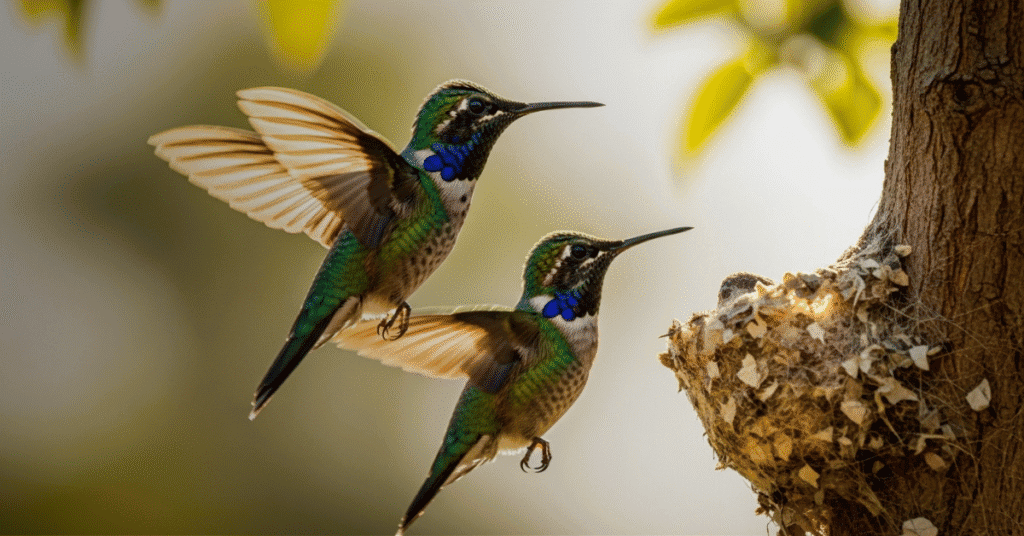
The energy requirements for this aerial mastery are staggering. A hummingbird’s heart beats up to 1,260 times per minute—roughly 20 beats per second. Their metabolic rate is approximately 10 times higher than that of a pigeon and 100 times higher than an elephant’s.
To fuel this biological furnace, hummingbirds must consume half their body weight in nectar daily. They visit between 1,000 and 2,000 flowers every day, supplementing their sugar-rich diet with small insects and spiders for protein and essential nutrients.
Research conducted by the Smithsonian Institution shows that hummingbirds have evolved specialized physiological adaptations to handle their extreme energy demands. Their kidneys process sugar at rates that would be toxic to other animals, while their liver rapidly converts nectar into usable energy.
The birds’ relationship with flowering plants represents one of evolution’s most elegant partnerships. Over millions of years, flowers have evolved specific shapes, colors, and nectar compositions to attract hummingbird pollinators, while the birds have developed specialized beaks and tongues perfectly matched to their preferred flowers.
Masters of Migration
Perhaps no feat better illustrates hummingbird resilience than their epic migrations. The ruby-throated hummingbird, weighing less than a penny, embarks on a 500-mile non-stop flight across the Gulf of Mexico twice each year.
Before this journey, the birds undergo a remarkable transformation. They nearly double their body weight by storing fat, their primary fuel for the 18-20 hour flight. During migration, their metabolic rate increases even further, burning through their fat reserves at an astonishing pace.
NASA satellite tracking studies have revealed that some hummingbird species travel over 3,000 miles during migration, navigating by stars, magnetic fields, and landmark recognition. The rufous hummingbird holds the record for longest migration relative to body size, traveling roughly 78,470,000 body lengths—equivalent to a human walking to the moon and back twice.
Surviving the Impossible
Hummingbirds face threats that would doom larger animals. Their size makes them vulnerable to everything from praying mantises to domestic cats. Weather poses constant dangers—a sudden storm can ground them for days, potentially leading to starvation.
To survive cold nights, hummingbirds enter a state called torpor, essentially hibernating while perched. Their heart rate drops to as few as 50 beats per minute, and their body temperature can fall by 50 degrees Fahrenheit. This adaptation allows them to reduce their metabolic rate by up to 95 percent, conserving precious energy reserves.
Territory defense consumes significant energy, yet hummingbirds are notoriously aggressive. Males will chase away birds many times their size from prime feeding locations. This behavior, while seemingly wasteful, ensures access to the high-quality nectar sources essential for survival.
Climate Challenges and Adaptation
Modern research reveals how hummingbirds adapt to environmental changes. Studies published in the Journal of Avian Biology show that some species are adjusting their migration timing in response to shifting flower blooming periods caused by climate change.
Urban environments present new challenges and opportunities. City-dwelling hummingbirds have learned to exploit artificial food sources like feeders and ornamental plants. Some populations show evidence of evolutionary changes, developing longer beaks to access urban flower varieties or adjusting their territorial behaviors to city life.
The birds’ extreme sensitivity to environmental changes makes them important indicators of ecosystem health. Scientists monitor hummingbird populations to track broader environmental trends, from habitat loss to climate shifts.
The Engineering Marvel
Recent advances in high-speed photography and computational modeling have revealed new details about hummingbird mechanics. MIT researchers discovered that hummingbirds generate vortices at their wingtips that help maximize lift efficiency—a principle now being applied to micro-drone design.
The birds’ ability to see ultraviolet light gives them access to nectar guides invisible to human eyes. Their tongues, once thought to work like straws, actually use capillary action and elastic recoil to rapidly lap nectar at rates up to 20 licks per second.
Brain imaging studies show that hummingbirds possess exceptional spatial memory, remembering the locations and refill rates of thousands of flowers. This cognitive mapping ability rivals that of much larger-brained animals.
A Testament to Life’s Tenacity
Hummingbirds exist at the absolute limits of what’s possible for a warm-blooded vertebrate. Their survival depends on a perfect storm of adaptations: specialized flight mechanics, extreme metabolic efficiency, precise navigation abilities, and behavioral flexibility.
These tiny marvels remind us that life finds ways to thrive in the most unlikely circumstances. In our rapidly changing world, understanding how hummingbirds overcome seemingly impossible odds may hold keys to broader questions about adaptation, resilience, and the remarkable tenacity of life itself.
As climate patterns shift and habitats change, hummingbirds continue to surprise researchers with their ability to adapt and persist. Their story is far from over—it’s a testament to the extraordinary ways life pushes against the boundaries of possibility, one wingbeat at a time.
Sources
• Warrick, D.R., et al. “Aerodynamics of the hovering hummingbird.” Nature, 2005 • Smithsonian National Museum of Natural History, “Hummingbird Research,” 2023 • Clark, C.J. “Courtship dives of Anna’s hummingbird offer insights into flight performance limits.” Proceedings of the Royal Society B, 2009 • MIT Department of Aeronautics and Astronautics, “Bio-inspired flight mechanics,” 2022 • Journal of Avian Biology, “Climate change impacts on hummingbird migration timing,” 2023 • NASA Goddard Space Flight Center, “Satellite tracking of migratory birds,” 2024 • Oregon State University Department of Integrative Biology, “Hummingbird flight research,” 2023 • University of California Museum of Paleontology, “Hummingbird evolution and diversity,” 2022
Disclaimer
This article is for informational purposes only and should not replace professional scientific advice regarding wildlife observation or conservation practices.