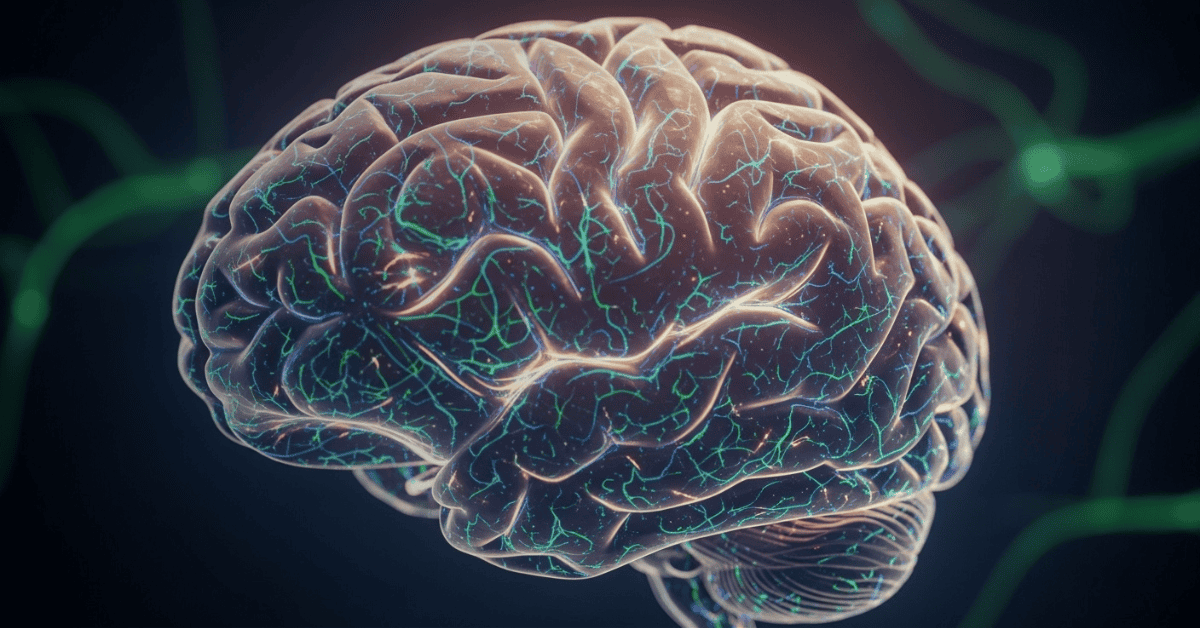
Your brain creates your reality before you’re even aware of it, constructing a vivid world from incomplete fragments through predictive processing that shapes every moment of your existence.
The Magician Behind Your Eyes
A woman stands in her kitchen, reaching for what appears to be a red apple on the counter. But here’s the startling truth: she has never actually seen that apple. Her brain, acting like a master magician, has conjured the apple’s redness, smoothness, and shape from scattered photons and electrical signals. The “apple” she experiences exists only in the theater of her mind.
This revelation isn’t philosophical speculation. It’s cutting-edge neuroscience that’s revolutionizing how we understand consciousness itself.
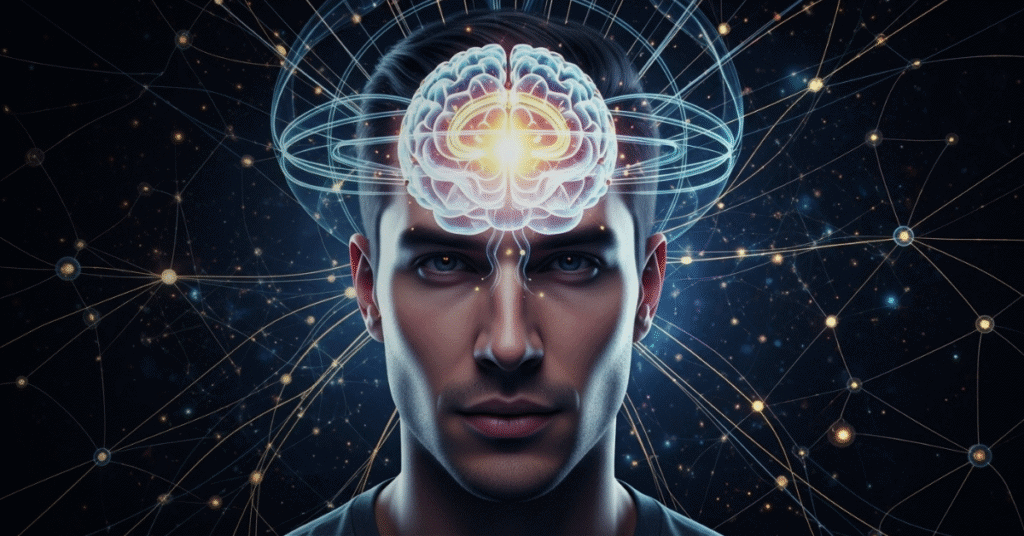
The Great Deception We Call Sight
For centuries, scientists believed vision worked like a camera. Light enters your eyes, creates an image on your retina, and your brain passively receives this picture. This intuitive model seemed obvious and logical.
German physicist Hermann von Helmholtz shattered this assumption in the 1860s. He proposed that perception involves active interpretation, not passive recording. Your brain makes educated guesses about reality based on incomplete information.
Modern neuroscience has vindicated Helmholtz’s radical insight. Research from MIT, Stanford, and other leading institutions reveals that your brain processes visual information through sophisticated prediction algorithms. These systems constantly generate hypotheses about what you’re seeing before the complete sensory data arrives.
The Prediction Machine in Your Skull
Your brain operates like a sophisticated weather forecasting system, but instead of predicting tomorrow’s rainfall, it predicts the next moment of your reality. This process happens through predictive processing, a mechanism discovered through decades of research by neuroscientists like Andy Clark and Jakob Hohwy.
Every millisecond, your brain generates millions of predictions about incoming sensory information. When light hits your retina, specialized cells called ganglion cells don’t simply transmit raw data. They compress and interpret this information before sending it up the visual pathway.
The primary visual cortex receives these signals and immediately begins constructing your visual experience. But here’s where it gets extraordinary: your brain fills in massive gaps using prior knowledge, expectations, and contextual clues.
Consider the blind spot in your vision. Each eye has a region where the optic nerve connects to the retina, creating an area with no photoreceptors. You should see a dark patch in your visual field, yet you don’t. Your brain seamlessly fills this gap, creating the illusion of continuous sight.
Building Reality From Fragments
Dr. Lisa Feldman Barrett’s groundbreaking research at Northeastern University demonstrates how extensively your brain constructs your experiences. Her studies reveal that emotions, like visual perceptions, are predictions your brain makes about your body’s sensory signals.
When you see a snake and feel fear, your brain has rapidly predicted danger based on the shape, movement pattern, and context. The fear exists before you consciously recognize the snake. Your brain has built an emotional reality from incomplete visual information.
This predictive processing extends far beyond vision. Your brain constructs your entire sensory world through similar mechanisms. The taste of chocolate, the feeling of silk, the sound of music—all are elaborate constructions created by your neural prediction machinery.
Research at the Wellcome Centre for Human Neuroimaging shows that your brain spends more energy on predictions than on processing actual sensory input. You live in a world of controlled hallucinations, carefully crafted by billions of neurons working in concert.
The Architecture of Illusion
Your visual system employs several remarkable construction techniques. Object recognition happens through a process called hierarchical feature detection. Simple cells detect edges and lines. Complex cells combine these features into shapes. Higher-level areas assemble these shapes into recognizable objects.
But your brain doesn’t wait for complete information. It makes rapid predictions based on partial data. See the curved edge of something red in your peripheral vision, and your brain might predict “apple” before confirming the details.
Top-down processing allows your expectations to influence what you perceive. In famous experiments, people shown ambiguous images see different objects depending on their recent experiences or cultural background. Your brain literally builds different realities from identical sensory input.
When Construction Fails
Understanding predictive processing helps explain various perceptual phenomena and disorders. Optical illusions occur when your brain’s predictions don’t match reality. The spinning dancer illusion demonstrates how your brain constructs three-dimensional movement from two-dimensional information.
Hallucinations in conditions like schizophrenia may result from disrupted prediction systems. When the brain’s predictive mechanisms malfunction, people experience vivid perceptions of things that aren’t physically present. The construction process continues, but without proper sensory constraints.
Charles Bonnet syndrome affects people with vision loss who experience complex visual hallucinations. Their brains continue generating visual predictions despite reduced sensory input, creating elaborate scenes of people, animals, and landscapes.
The Global Construction Project
Predictive processing appears throughout the animal kingdom, suggesting it’s a fundamental feature of complex nervous systems. Research indicates that many mammals, birds, and even some invertebrates employ similar prediction-based systems.
Dolphins use echolocation to build sonic maps of their environment. Their brains must predict and construct three-dimensional models from sound waves bouncing off objects. This process parallels human visual construction but uses entirely different sensory inputs.
Cultural factors also influence how brains construct reality. Studies show that people from different cultures literally see the same images differently. Western cultures tend to focus on central objects, while East Asian cultures pay more attention to background context. These differences reflect learned prediction patterns shaped by cultural experience.
The Future of Reality
As virtual and augmented reality technologies advance, understanding predictive processing becomes increasingly important. These systems succeed by hijacking your brain’s construction mechanisms, feeding it artificial sensory input that creates convincing alternate realities.
Researchers are developing brain-computer interfaces that could directly influence predictive processing. Such technologies might help treat conditions like depression, chronic pain, or PTSD by modifying how the brain constructs emotional and sensory experiences.
The implications extend to artificial intelligence. Machine learning systems increasingly use prediction-based approaches similar to biological brains. Understanding how your brain builds reality could inspire more sophisticated AI systems.
The Wonder of Construction
Every moment of your conscious experience represents an extraordinary feat of neural engineering. Your brain transforms electromagnetic radiation into colors, air pressure variations into music, and molecular interactions into flavors. This biological magic happens so seamlessly that you mistake the construction for reality itself.
The next time you admire a sunset, remember that the blazing oranges and purples exist nowhere but in the predictions your brain builds from scattered photons. You are not a passive observer of reality—you are its active creator, constructing each moment of experience from the raw materials of sensation and memory.
This revelation doesn’t diminish the wonder of consciousness; it amplifies it. Understanding how your brain builds your reality opens new frontiers in neuroscience, medicine, and technology, promising insights that could reshape our understanding of what it means to be human.
Sources
• Barrett, L. F. (2017). How Emotions Are Made: The Secret Life of the Brain. Houghton Mifflin Harcourt • Clark, A. (2013). Predictive Processing and the Free-Energy Principle. Frontiers in Psychology • Helmholtz, H. von (1867). Handbuch der physiologischen Optik. Leopold Voss • Hohwy, J. (2013). The Predictive Mind: Cognitive Science and Philosophy of Mind. Oxford University Press • MIT Department of Brain and Cognitive Sciences (2019-2023). Visual Processing Research • Northeastern University Psychology Department, Barrett Lab (2015-2023). Emotion and Prediction Studies • Stanford Neuroscience Institute (2020-2023). Predictive Coding Research • Wellcome Centre for Human Neuroimaging, University College London (2018-2023). Brain Energy and Prediction Studies
Disclaimer: This article is for informational purposes only and should not replace professional medical or scientific advice. Consult qualified professionals for specific questions about neurological conditions or treatments.