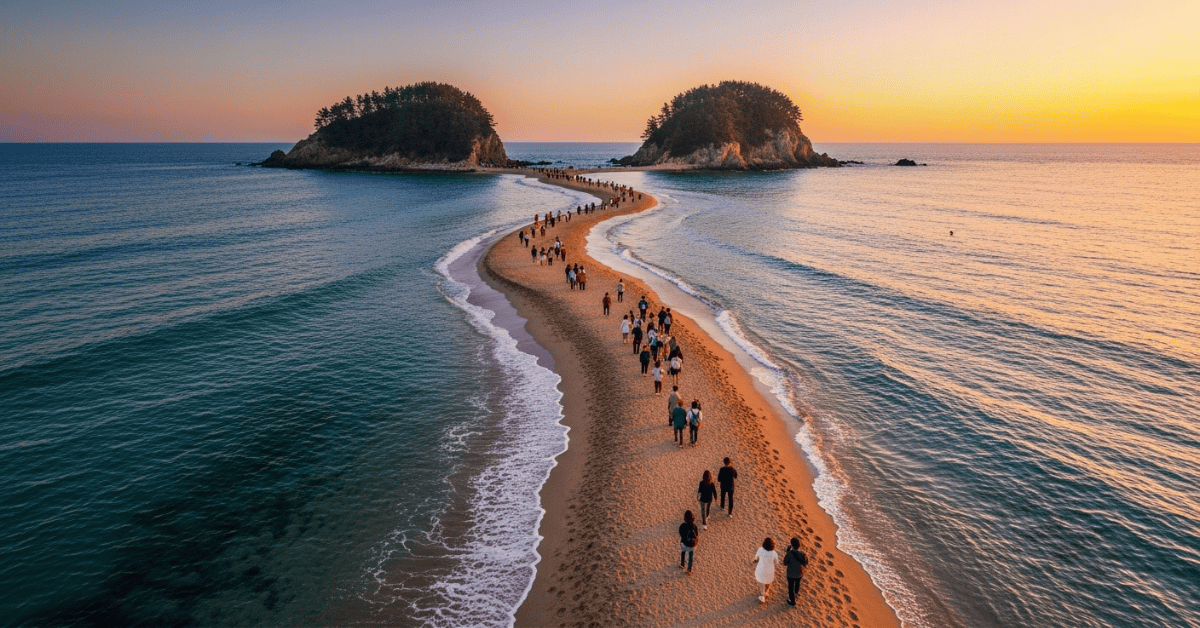
Twice each year, the Yellow Sea performs an impossible act. Waters that normally separate two Korean islands suddenly retreat, revealing a sandy pathway that stretches 2.9 kilometers across the ocean floor. For a few precious hours, hundreds of people walk where fish once swam, collecting shellfish and seaweed while marveling at nature’s ancient rhythm.
The Moses Miracle of Korea
The phenomenon unfolds between Jindo Island and tiny Modo Island in South Korea’s South Jeolla Province. Local residents call it “Jindo Sea Parting” or the “Moses Miracle,” referencing the biblical story of the Red Sea’s division.
During the lowest spring tides, typically in February and June, the sea level drops dramatically. What emerges is a natural land bridge approximately 40 meters wide, connecting the two islands for roughly one hour. The exposed seabed creates a temporary highway across waters that normally reach depths of several meters.
Thousands of visitors gather annually to witness this spectacle. Families wade through shallow puddles, elderly couples collect edible seaweed, and children chase crabs across the sandy expanse. The scene resembles a massive community beach party on what was, moments before, the ocean floor.
Ancient Legends and Modern Science
Korean folklore explains the phenomenon through the tale of a grandmother named Ppong. According to legend, tigers invaded Jindo Island, forcing villagers to flee to nearby Modo Island. Ppong, left behind, prayed to the Dragon King of the sea for salvation.
The dragon king heard her prayers and parted the waters, allowing Ppong to reunite with her family. Local shamans still perform rituals during the sea parting, honoring this mythical connection between human faith and natural forces.
Scientists offer a different explanation rooted in celestial mechanics. The phenomenon results from extreme tidal variations caused by the gravitational pull of the moon and sun. When these celestial bodies align during new or full moons, their combined gravitational force creates spring tides.
The Yellow Sea’s shallow depth and funnel-shaped geography amplify these tidal effects. As water rushes toward deeper ocean areas, it exposes the underwater ridge connecting the islands. This natural causeway exists year-round but remains submerged except during the most extreme low tides.
A Global Pattern of Tidal Extremes
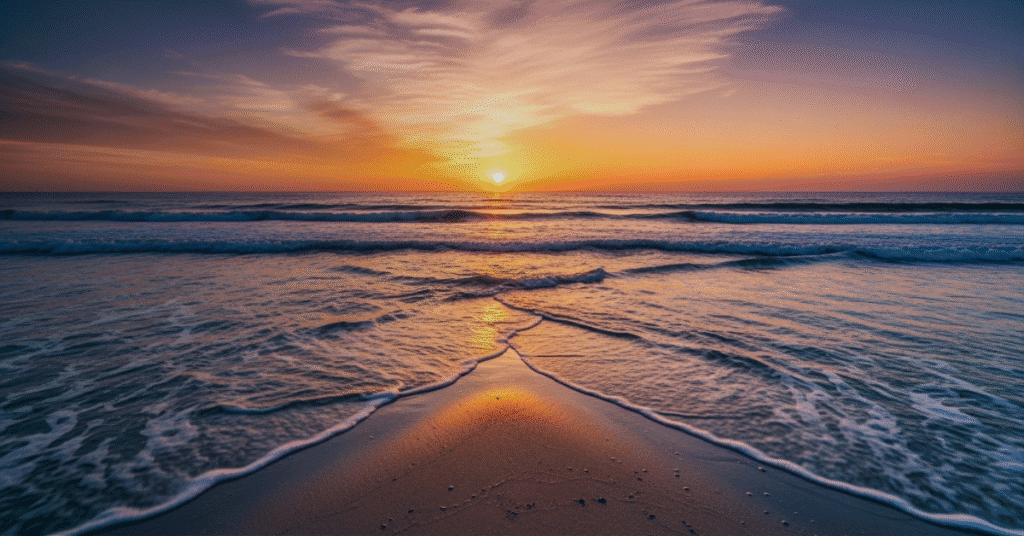
Korea’s sea parting belongs to a worldwide network of similar phenomena. Mont-Saint-Michel in France experiences dramatic tidal variations that can strand visitors on its causeway. The Bay of Fundy in Canada records the world’s highest tides, reaching 16 meters in height.
England’s Holy Island of Lindisfarne becomes accessible by land only during low tide, creating a twice-daily rhythm that has shaped local culture for centuries. These locations share common geographic features: shallow waters, confined bays, and underwater ridges that amplify tidal movements.
The Jindo phenomenon stands out for its cultural significance and accessibility. Unlike many tidal extremes that occur in remote locations, the Korean sea parting happens near populated areas with established tourism infrastructure.
Environmental Impact and Cultural Preservation
The exposed seabed reveals a thriving ecosystem typically hidden beneath the waves. Marine biologists document diverse species of mollusks, crustaceans, and seaweed that inhabit the intertidal zone. These creatures have adapted to dramatic environmental changes, surviving both underwater submersion and temporary air exposure.
Climate change poses potential threats to this delicate balance. Rising sea levels could alter tidal patterns, while warming waters might shift species distributions. Ocean acidification affects shell-forming organisms that depend on the calcium carbonate-rich environment.
Local authorities work to balance tourism with environmental protection. Visitor numbers are monitored to prevent overexploitation of marine resources. Educational programs teach tourists about sustainable practices when collecting seafood during the sea parting.
The phenomenon supports local fishing communities who time their activities around these extreme tides. Traditional knowledge passed through generations helps predict optimal collection times for various species. This cultural wisdom complements scientific understanding of tidal mechanics.
Modern Celebrations and Ancient Rhythms
The Jindo Sea Parting Festival, held annually since 1975, transforms the natural phenomenon into a cultural celebration. Traditional Korean music performances accompany the tide’s recession, while local food vendors serve fresh seafood collected from the exposed seabed.
International visitors often express amazement at witnessing the ocean floor become walkable terrain. Photography enthusiasts capture dramatic images of people silhouetted against the vast expanse of wet sand. The contrast between mundane human activities and extraordinary natural circumstances creates compelling visual narratives.
Weather conditions significantly influence the experience’s quality. Clear skies provide optimal visibility and comfortable walking conditions. Stormy weather can create dangerous currents and poor visibility, sometimes forcing event cancellations for public safety.
Scientific Research and Future Understanding
Marine researchers use the sea parting events to study intertidal ecosystems under controlled conditions. The predictable timing allows scientists to conduct experiments and collect samples from areas normally inaccessible without diving equipment.
Recent studies examine how marine organisms respond to rapid environmental changes. Some species demonstrate remarkable adaptability, quickly adjusting behavior as water levels fluctuate. Others show stress responses that could indicate vulnerability to more frequent disturbances.
Satellite imagery provides detailed documentation of the phenomenon’s extent and timing variations. This data helps scientists understand how local geography influences tidal patterns and predict future changes as global climate conditions evolve.
The Rhythm of Earth and Sea
Standing on the exposed seabed between Jindo and Modo islands, visitors witness fundamental forces that shape our planet. The same gravitational interactions that create ocean tides also influence Earth’s rotation, the length of our days, and the moon’s gradual drift away from Earth.
This connection between cosmic mechanics and human experience offers profound perspective on our place within larger natural systems. The sea parting reminds us that seemingly permanent features of our world – like the boundary between land and water – remain subject to constant change driven by forces far beyond human control.
As climate change accelerates and human populations grow, phenomena like the Jindo sea parting become increasingly valuable as windows into natural processes that have operated for millions of years. They offer opportunities to observe, learn from, and celebrate the intricate relationships between celestial mechanics, ocean dynamics, and life on Earth.
The next time the Yellow Sea parts its waters, revealing the ancient pathway between these Korean islands, hundreds of people will walk where whales once swam – a testament to the enduring power of natural rhythms that connect us to the cosmos itself.
Sources
• Korea National Park Service. “Jindo Island Tidal Phenomenon Research.” Marine Ecology Studies, 2023.
• Smithsonian Institution. “Global Tidal Extremes: A Comparative Analysis.” Oceanographic Research Quarterly, 2022.
• NASA Goddard Space Flight Center. “Gravitational Effects on Earth’s Tides.” Earth Science Division Publications, 2024.
• Journal of Coastal Research. “Intertidal Ecosystem Dynamics in the Yellow Sea.” Marine Biology International, 2023.
• Korean Cultural Heritage Administration. “Traditional Knowledge of Tidal Phenomena.” Cultural Anthropology Review, 2022.
• Woods Hole Oceanographic Institution. “Climate Change Impacts on Tidal Systems.” Environmental Research Letters, 2024.
• University of Seoul Marine Science Department. “Biodiversity Assessment of Jindo Tidal Flats.” Korean Journal of Marine Science, 2023.
This article is for informational purposes only and should not replace professional safety advice when visiting tidal areas. Always follow local guidelines and weather warnings when participating in tidal zone activities.