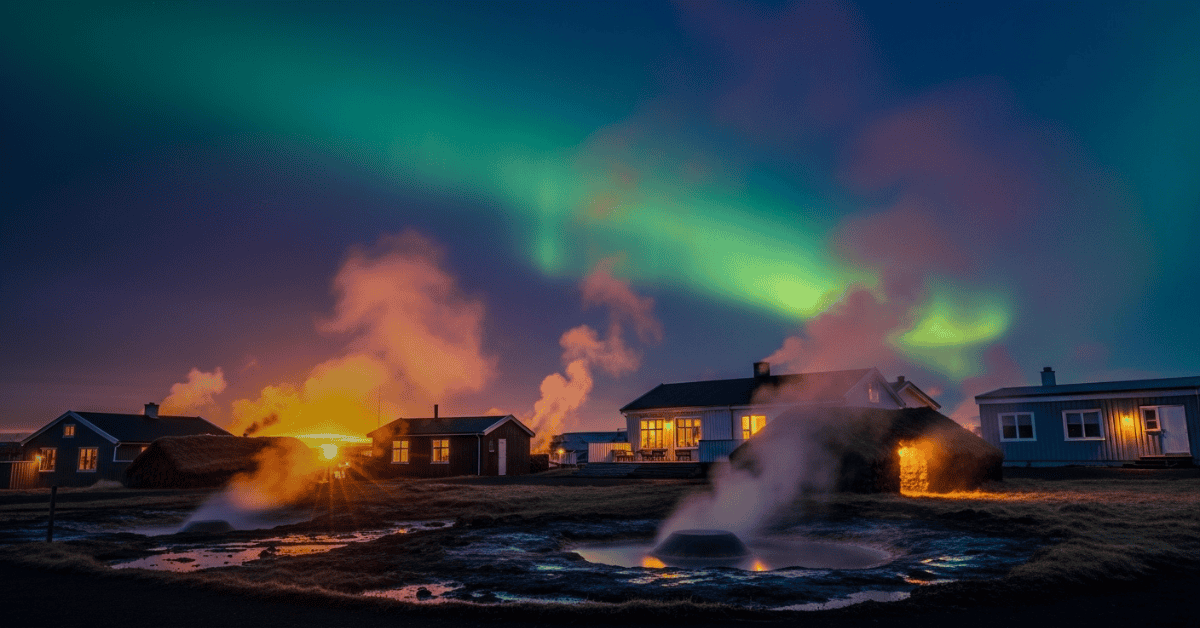
Steam billows from the earth like dragon’s breath across Iceland’s volcanic landscape. Beneath your feet, the planet’s molten heart churns just two miles below the surface—closer than anywhere else on Earth. This proximity to geological fire has transformed Iceland into a living laboratory for sustainable energy, where 90% of homes stay warm through winter using nothing but the Earth’s own heat.
A Nation Built on Fire and Ice
Iceland sits astride the Mid-Atlantic Ridge, where two massive tectonic plates slowly drift apart at a rate of two centimeters per year. This geological positioning creates a unique energy goldmine. The island nation experiences volcanic eruptions every four years on average, and hot springs dot the landscape like natural jacuzzis scattered across a frozen wilderness.
For centuries, Icelanders have witnessed this raw power. Early settlers in the 9th century discovered natural hot pools and used them for bathing and washing clothes. Archaeological evidence shows Vikings were already harnessing geothermal energy over 1,000 years ago, though they had no understanding of the scientific principles at work.
The modern story begins in 1930 when Iceland first experimented with piping hot water from natural springs directly into buildings in Reykjavik. By 1943, the capital city had established its first district heating system, marking the beginning of what would become the world’s most comprehensive geothermal heating network.
Tapping the Earth’s Underground Furnace
Today’s geothermal systems work like massive underground radiators. Engineers drill deep wells, some reaching 6,000 feet into the earth, where temperatures soar above 200 degrees Celsius. Superheated water rises naturally through these wells, creating a continuous flow of energy that never runs out.
The process begins in geothermal power plants scattered across Iceland’s landscape. High-temperature wells produce steam that spins turbines to generate electricity. Meanwhile, lower-temperature wells feed into district heating systems that warm entire neighborhoods through underground pipe networks.
Reykjavik Energy, the city’s main utility company, operates the world’s largest geothermal district heating system. Hot water travels through 1,200 miles of insulated pipes buried beneath streets and sidewalks. The water arrives at homes and buildings at temperatures between 80-90 degrees Celsius, providing both space heating and hot water for daily use.
This system heats 95% of Iceland’s buildings while producing virtually zero carbon emissions. The only byproduct is slightly cooled water, which returns to underground reservoirs to be naturally reheated by the Earth’s core.
Beyond Heating: A Geothermal Renaissance
Iceland’s geothermal mastery extends far beyond home heating. The Blue Lagoon, one of the world’s most famous spas, operates using wastewater from a nearby geothermal power plant. The milky blue waters, rich in silica and minerals, maintain temperatures around 37-40 degrees Celsius year-round.
Innovative applications continue emerging. Geothermal energy now powers massive data centers that house computer servers for international tech companies. The naturally cool climate requires minimal additional cooling, while abundant clean energy makes Iceland an attractive location for energy-intensive industries.
Farmers use geothermal heating to grow tropical fruits in greenhouses throughout the harsh Arctic winter. Bananas, tomatoes, and even exotic flowers flourish in these heated sanctuaries while snow blankets the ground outside.
The fishing industry, Iceland’s economic backbone, relies on geothermal energy for processing plants and fish drying facilities. Even sidewalks in downtown Reykjavik stay ice-free through embedded geothermal heating pipes.
Lessons for a Warming World
Iceland’s success offers a blueprint for other geologically active regions. The Philippines, New Zealand, Kenya, and parts of the western United States possess similar geothermal potential. Countries along the Pacific Ring of Fire could potentially harness their underground heat sources to reduce dependence on fossil fuels.
However, Iceland’s unique advantages make replication challenging. The island’s small population of 370,000 people creates manageable infrastructure demands. Additionally, sitting directly on a tectonic plate boundary provides exceptional access to shallow geothermal resources that most countries lack.
Climate scientists emphasize that geothermal energy could play a crucial role in global decarbonization efforts. Unlike solar and wind power, geothermal systems provide constant, reliable energy regardless of weather conditions. This baseload reliability makes geothermal power particularly valuable for maintaining stable electrical grids.
Recent technological advances in enhanced geothermal systems could unlock this clean energy source in areas previously considered unsuitable. These new drilling techniques can access heat sources at greater depths, potentially expanding geothermal availability to regions without natural hot springs or volcanic activity.
Economic and Environmental Impact
Iceland’s geothermal transition has delivered remarkable economic benefits. The country imports virtually no fossil fuels for heating, saving millions of dollars annually while insulating the economy from volatile oil and gas prices. Energy costs remain among the lowest in the world, providing competitive advantages for energy-intensive industries.
Environmental impacts extend beyond carbon reduction. Geothermal systems require minimal land use compared to other renewable energy sources. A single geothermal plant can operate for decades with minimal environmental disruption, while wind and solar installations require vast areas of land to generate equivalent energy.
Air quality improvements have transformed Reykjavik from a smog-filled city burning coal and oil into one of the world’s cleanest capitals. Residents enjoy crisp, clean air year-round, contributing to Iceland’s ranking among the world’s healthiest countries.
The technology also provides energy security independence. Iceland’s geothermal resources are estimated to last thousands of years at current consumption rates, offering long-term stability in an increasingly uncertain global energy landscape.
The Future Underground
Iceland continues pushing geothermal boundaries through ambitious research projects. The Deep Drilling Project aims to reach depths of 10,000 feet, accessing temperatures above 400 degrees Celsius that could revolutionize electricity generation efficiency.
Scientists are exploring ways to capture carbon dioxide from the atmosphere and inject it into underground geothermal reservoirs, where it mineralizes into solid rock. This process could transform geothermal plants from clean energy producers into active carbon removal systems.
International cooperation expands Iceland’s influence beyond its borders. Icelandic engineers now consult on geothermal projects worldwide, sharing expertise gained from decades of practical experience. The country has become a global center for geothermal education, hosting students and researchers from around the world.
As global temperatures rise and pressure mounts to transition away from fossil fuels, Iceland’s geothermal success story offers both inspiration and practical solutions. The island nation proves that with the right geological conditions and long-term vision, communities can harness the Earth’s own energy to build sustainable, prosperous societies.
Standing above Iceland’s steaming landscape, watching natural forces that have shaped our planet for billions of years, one realizes the immense power lying beneath our feet—power that could help heal the climate crisis one geothermally heated home at a time.
Sources
• National Renewable Energy Laboratory, “Geothermal Energy Basics” (2023) • Iceland National Energy Authority, “Energy Statistics 2023” • Nature Geoscience, “Enhanced geothermal systems in volcanic settings” (2022) • International Renewable Energy Agency, “Global Energy Transformation: Geothermal” (2023)
• Smithsonian National Museum of Natural History, “Volcanoes and Plate Tectonics” (2022) • World Health Organization, “Ambient Air Quality Database” (2023) • Reykjavik Energy, “District Heating System Operations Report” (2023) • Journal of Volcanology and Geothermal Research, “Iceland’s geothermal resource potential” (2022)
This article is for informational purposes only and should not replace professional energy or geological advice.