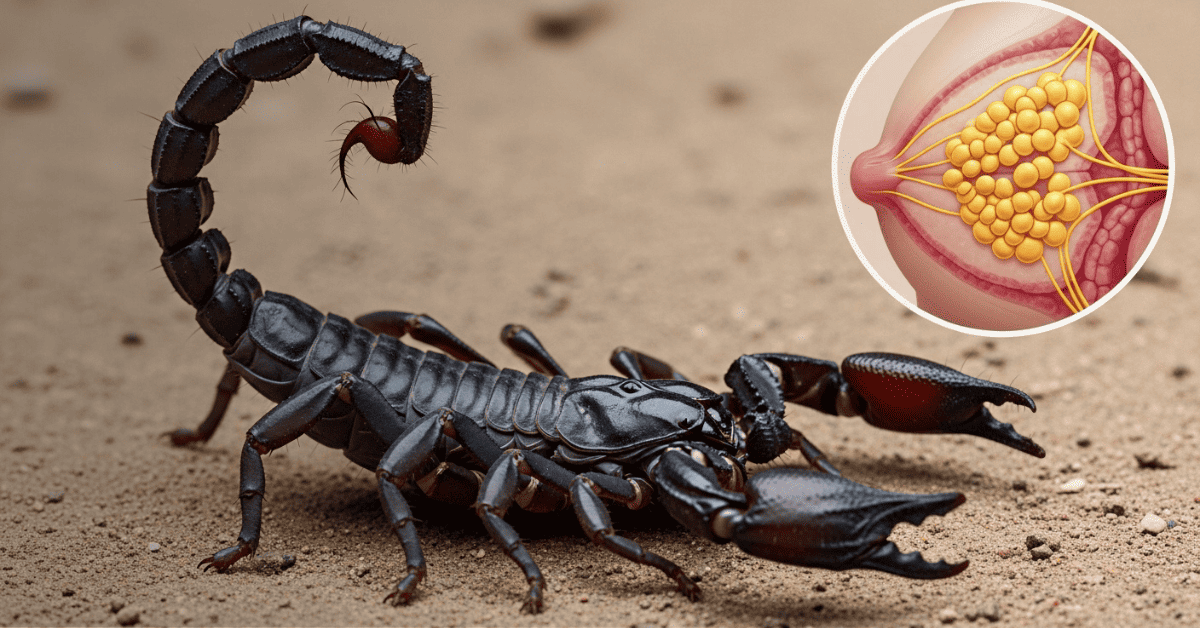
Deep in the Amazon rainforest, a tiny predator carries within its tail a weapon that has remained unchanged for millions of years. Today, scientists discover this ancient venom may hold keys to fighting one of humanity’s greatest health challenges.
In the shadows of Venezuela’s dense tropical forests, the Tityus discrepans scorpion moves with calculated precision. This unassuming arachnid, barely three inches long, possesses a chemical arsenal that evolution refined over 400 million years. Scientists now believe this ancient weapon system could revolutionize how we treat breast cancer.
Ancient Predators Meet Modern Medicine
The relationship between venomous creatures and human healing stretches back millennia. Ancient Egyptian physicians used cobra venom for pain relief. Traditional Chinese medicine has incorporated scorpion preparations for over 2,000 years. However, modern scientific investigation of these natural compounds began only recently.
Scorpion venom represents one of nature’s most sophisticated chemical weapons. Each drop contains dozens of peptides, proteins, and enzymes designed to paralyze prey and defend against threats. These molecules work with surgical precision, targeting specific cellular pathways in ways that often surpass synthetic drugs.
The human fascination with harnessing nature’s pharmacy has led researchers to examine venoms from creatures across the globe. From cone snails to pit vipers, scientists have discovered compounds that treat everything from chronic pain to heart conditions.

Breaking Cancer’s Defenses
Recent research reveals how scorpion venom attacks cancer cells through multiple pathways simultaneously. Proteins found in T. discrepans venom bind to FasL and Bcl-2 on the surface of breast cancer cells inducing apoptosis, essentially forcing malignant cells to self-destruct.
The mechanism resembles a precision military operation. Venom peptides infiltrate cancer cells and trigger apoptosis, the cellular equivalent of programmed death. Unlike chemotherapy drugs that damage healthy and cancerous cells alike, these natural compounds demonstrate remarkable selectivity.
Tityus discrepans scorpion venom and its isolated peptides neopladine 1 and neopladine 2 decrease cell viability and induce apoptosis and necrosis in human breast cancer cells with a negligible effect on non-malignant cells. This selectivity represents a holy grail in cancer treatment: destroying tumors while leaving healthy tissue unharmed.
Multiple Species, Multiple Solutions
The therapeutic potential extends far beyond a single scorpion species. Research teams worldwide have identified promising compounds from various scorpion venoms. The Chinese scorpion Buthus martensii produces peptides that arrest breast cancer cells in their growth cycle. Middle Eastern species like Hottentotta saulcyi show similar anti-cancer properties.
Each species evolved unique venom compositions based on their prey, predators, and environment. This diversity creates a natural library of potential medicines, each with distinct mechanisms of action.
Scientists have isolated over 100,000 different venom components from scorpions alone. Of these, researchers have studied fewer than one percent for medical applications. The untapped potential remains enormous.
From Laboratory to Patient
The journey from venom extraction to cancer treatment involves numerous technological hurdles. Scientists must first identify and isolate active compounds from complex venom mixtures. They then synthesize these molecules in laboratory settings, ensuring purity and consistency.
Researchers have isolated an analgesic-anti-tumor peptide from the venom of Buthus martensii Karsch (BmK AGAP), which exhibits remarkable anti-tumor activity, though limited bioavailability of peptides poses a challenge for their therapeutic efficacy.
Bioavailability represents a significant challenge. Natural peptides often break down quickly in the human body before reaching their targets. Scientists are developing innovative delivery systems, including engineered bacteria that carry venom peptides directly to tumor sites.
Clinical Trials and Real-World Applications
While breast cancer research shows promise, scorpion venom compounds have already entered clinical trials for other cancers. Using a component of scorpion venom called chlorotoxin (CLTX), researchers were able to target cancerous cells without affecting nontumor cells in the brain or in other organs.
These early trials focus on glioblastoma, an aggressive brain cancer with few treatment options. The success of chlorotoxin in precisely targeting brain tumors provides a blueprint for similar approaches in breast cancer treatment.
The transition from laboratory bench to patient bedside typically requires 10-15 years and hundreds of millions of dollars in development costs. However, the promising results from multiple research centers worldwide suggest this timeline may accelerate.
Global Impact and Future Possibilities
Breast cancer affects over 2.3 million women worldwide each year, making it the most common cancer among women. Current treatments, while increasingly effective, often cause significant side effects that impact quality of life. Scorpion venom compounds could change this equation dramatically.
The precision targeting demonstrated by venom peptides addresses one of oncology’s greatest challenges: destroying cancer while preserving healthy tissue. This selectivity could reduce chemotherapy’s notorious side effects, from hair loss to immune system suppression.
Despite breakthroughs in the development of cancer diagnosis and therapy, most current therapeutic approaches lack precise specificity and sensitivity, resulting in damage to healthy cells. Selective delivery of anti-cancer agents is thus an important goal of cancer therapy.
Conservation and Biodiversity
The medical potential of scorpion venom highlights the importance of biodiversity conservation. Many species remain unstudied, and habitat destruction threatens to eliminate potential sources of life-saving compounds before scientists can investigate them.
Pharmaceutical companies increasingly recognize that preserving ecosystems protects not only wildlife but also future medical discoveries. The Amazon rainforest alone may harbor hundreds of scorpion species, each with unique venom compositions.
Climate change and deforestation accelerate species extinction rates, potentially destroying medical compounds before researchers can study them. This reality adds urgency to both conservation efforts and venom research programs.
Looking Forward
The convergence of ancient evolution and modern medicine opens extraordinary possibilities. As researchers decode the secrets held in scorpion venom, they unlock new approaches to treating diseases that have plagued humanity for centuries.
Multiple scientific investigations have shown that particular scorpion venoms induce apoptosis and inhibit the development of cancerous cells, suggesting that nature perfected targeted cancer treatments long before humans understood the disease itself.
The path ahead requires continued research, careful clinical trials, and innovative delivery systems. Yet the early results provide hope that the same venom that once protected scorpions in primordial seas may now protect human lives in modern hospitals.
As we stand at this intersection of ancient biology and cutting-edge medicine, one truth emerges clearly: the natural world continues to offer solutions to our most pressing challenges, if only we have the wisdom to listen and the science to understand.
Sources
• Memorial Sloan Kettering Cancer Center – Scorpion Venom Research Database • Scientific Reports – “Anticancer potentiality of Hottentotta saulcyi scorpion curd venom against breast cancer” (2024) • PMC – “Scorpion and spider venoms in cancer treatment: state of the art, challenges, and perspectives” • Bioresources and Bioprocessing – “Harnessing the potency of scorpion venom-derived proteins: applications in cancer therapy” (2024) • Current Microbiology – “Engineered Bacteria-Mediated Delivery of Scorpion Venom Peptide AGAP for Targeted Breast Cancer Therapy” (2025) • Clinical Medicine – “Systematic Review of the Antitumor Activities and Mechanisms of Scorpion Venom on Human Breast Cancer Cells Lines” (2025) • National Foundation for Cancer Research – Scorpion Venom Cancer Treatment Research (2025) • PubMed – “Scorpion venom induces apoptosis by depolarization of mitochondria in human breast cancer cells”
Disclaimer
This article is for informational purposes only and should not replace professional medical advice. Patients should consult with qualified healthcare providers regarding cancer treatment options and clinical trials.